KFTC Blog
August-26-2010
Attention electricians, plumbers, HVAC contractors
Join MACED and water heating and space heating experts to learn the latest in energy efficiency at a free Lunch and Learn on September 2 in Paintsville.
Electricians, plumbers, HVAC contractors, solar installers, energy managers, and operations teams are welcome.
Location:
Time, Date:
10 a.m. to 2:30 p.m. Thursday, September 2, 2010
Topics:
- Heat pump technology
- Geo-exchange waste heat recovery
- Gas condensing technology
- Tankless water heating systems for water and hydronic space heating applications
- Solar water heating systems
Speakers:
For more information or to reserve your seat, contact Elizabeth Graves at 859-986-2373.
August-24-2010
KFTC describes Renew East Kentucky in Solutions
Check out this
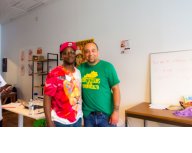
article by KFTC’s own Sara Pennington and Randy Wilson (pictured below) in the latest issue of the
journal Solutions, which focuses on the future of Appalachia. 
Pennington is a KFTC organizer, and Wilson is a long-time KFTC member and fifth-generation Appalachian who lives in Clay County.
Read about a plan called Renew East Kentucky that would create thousands of jobs and help the region transition to a more diverse economy.
Renew East Kentucky would be a five-year energy efficiency and renewable energy initiative to retool and expand the local workforce, build up local initiatives already in place, and more aggressively implement solutions to address the region’s infrastructure and economic challenges.
Why does Wilson think Renew East Kentucky is a good idea? “We need options in energy, and we need options in work,” he said.
Wilson is doing an oral history project in coal-producing communities, and he’s finding that lots of folks are ready for change. Like John Craft, who mined coal in Eastern Kentucky for 20 years. As the article describes, Craft sees coal production declining and envisions a sustainable economy built on clean energy like wind, solar and micro-hydro.
Renew East Kentucky is a chance to use the infrastructure we already have – rural electric cooperatives – to transition to a clean energy economy and create thousands of new jobs. Because the co-ops are member-run, real people at the local level would lead this transition and the new jobs would be the kind we need – clean and sustainable.
“The word is power,” Wilson said. “Giving people power to make choices.”
The People Behind Coal in Colombia and Kentucky - post 3
Our goal was to explore the connections between the impacts of the coal industry in Kentucky and Colombia. An important part of the exchange and the high point for many was a celebration of culture and an exchange of the things that people in both places love about where they are from.
A delegation of 5 from Kentucky - including 3 KFTC members and 2 staff - participated in this Witness for Peace trip, which was focused on "The People Behind the Coal in Appalachia and Colombia." The exchange began with a tour of mountain communities impacted by coal mining in Eastern Kentucky. From July 19th to July 26th, the group traveled on to Colombia. We spent the week learning about the impacts of the coal industry on Colombian communities in a northern coastal region called Cesar.
In a village called Tamaquito, we sat under a cool canopy of trees in mud huts with palm thatched roofs. KFTC member Randy Wilson took a moment of space to do some pickin' for the villagers. People were immediately at ease, and the space filled with laughter and song.
Randy Wilson's Banjo in Tamaquito, Colombia from Kentuckians For The Commonwealth on Vimeo.
The villagers then performed a dance for us where the women, covered from head to ankle in flaming red capes, circled the open ground to the sound of a drum. Then one woman was joined by one man and they twirled together in an intense circle, rounding one another and bumping shoulders.
After the dance, the villagers fed us a rich meal of marinated rice and goat meat. We talked as much as we could with them and played with the children who ran all around us. It started to rain and we quieted, sitting under the shade and listening to the sounds of the drops in this beautiful little village. With only one solar panel in the village, no one went inside their homes during this pleasant afternoon rain, but sat watching, experiencing it instead.
When we asked the villagers what they loved about the place they call home, several of them smiled. One said, “When the sun sets and night falls it is dark, we know where we are. We are not lost. Once, we lived in peace here.”
Tamaquito is being forcibly displaced from their land by a coal mining company. We're losing communities and cultures like them around the world at a rapid clip, due to our driving demand to consume. As Randy Wilson said, "The very people who know how to live sustainably, who figured this out long, long ago, are being displaced by a society whose principles and policy don’t have a clue."
The hope we can find is in communities standing together to learn from one another and to protect the values, the culture and the possibilities of transition that still remain here in Kentucky and abroad.
To learn more about the issues and the trip, plan to attend KFTC’s Annual Meeting and participate in a multi-media presentation about the trip.
August-23-2010
Harlan County Fish Pond Hit Again by Mining
Nearly three years ago, Elmer Lloyd began a journey for justice on his property in Cumberland, KY after the Nalley & Hamilton owned strip mine above his home completely devastated his family's fish pond. Excessive drainage of toxins, sediment, and mud killed hundreds of fish and nearly filled in the entire pond, as shown by video footage here. Years of lawyers, inspectors, court battles, and coal company lies, ended in Elmer having to settle with the company.
“I fully believed there were enough laws to protect my property. Boy was I wrong.” Elmer, disabled underground coal miner, says of the tragedy. This past November Elmer received his small settlement and began a new journey to restore his pond. Since then he has spent nearly three thousand dollars on the restoration.
Late last week, the site above Elmer's home, now considered “reclaimed”, released another slide of silt and mud into his pond. “We had some rain, but the stream coming off Pine Mountain [onto my property] was crystal clear. The stream running off that strip job was thick mud running right into my pond.”
Inspectors came out but were resistant to give Elmer any information. They told Elmer they would be in touch about the water samples they took, and they couldn't write a violation if the company was in compliance.
“They probably won't give them an off permit violation because of all the mess I made about it the last time. They know I won't shut up about it and I'll stay right on 'em.”
Elmer is hopeful that this incident isn't as detrimental, although still very damaging. He is yet to find any dead fish, but it will take some work to fix it. If his pond takes a couple similar hits to this one, it will be right back to the destroyed state it was three years ago.
A lot of people around here have serious damage to their homes and property, but are scared to talk about it because them or their families work in the mines. I'm just a drop in the bucket, but I don't care to tell about it.
Weekend Voter Work at the East End Reunion
KFTC members Janet Tucker and Tayna Fogle took turns this past weekend visiting the East End Reunion in Lexington, registering voters and talking about restoration of voting rights for former felons.
The day started out slow, but by 7 p.m., the event had attracted many hundreds of participants.
Tayna Fogle returned with over 100 postcards filled out, calling on our legislators to restore voting rights to all former felons who have served their debt to society. She also took the opportunity to take the microphone and do a little mass education about the issue.
"It was so much fun," Tayna said. "We met a lot of people who are really with us that night."
August-20-2010
Join KFTC's delegation to Appalachia Rising
Join KFTC's delegation to a conference and day of action focused on transition and the future of Appalachia. The events aim to advance
the dialogue about current energy extraction practices, with a specific
focus on ending mountaintop removal coal mining, and advocate for a
renewable energy future for Appalachia on a national stage
"We envision a vibrant weekend during which thousands will learn
about the challenges Appalachia faces and ways to build a movement to
end the destruction and plant the seeds of a sustainable and prosperous
Appalachia," said the organizers of the events.
The conference, entitled Voices from the Mountains, will be held on
September 25-26, 2010. Organizers of the Voices from the Mountain
conference are planning a space for regional participants to grow and
connect through strategy sessions, workshops, learning, and cultural
events. Topics will include both exploration of the issues facing the
region and ways to move forward.
The day following the
conference, September 27th, many people from the Appalachian region
will gather with conference attendees for a day of mobilization and
rallying on Capitol Hill. 2000 people, including movement leaders from
the region, celebrities such as Ashley Judd and Silas House, and many
Appalachian residents are expected to gather.
Click here to sign up or learn more.
August-18-2010
Recognition from the US Census
Videos from Georgetown Singing For Democracy
Here are some videos that cover a part of the Georgetown Singing for Democracy event a few weeks ago.
Thanks to Rick Traud, of the Northern KY KFTC Chapter for taking a crack at videotaping this even though he'd never used the video camera before.
Voices From Fancy Farm
We got a lot of good quotes and feedback from our KFTC delegation to Fancy Farm last week. Here they are.
"It feels good to be down here with all these members of KFTC getting our issues out there at a wonderful event and a huge part of Kentucky politics. Everybody else should come down next year!" - Danny Cotton, Central KY KFTC
"There was a lot of tension and... it was so partisan. To encounter people and say ‘we’re a non-partisan, grassroots organization. I think people from all kinds of backgrounds responded to that and seemed more open to what we had to say. That was really cool." - Meredith Wadlington, Bowling Green KFTC
"I think KFTC made a huge difference to the whole landscape of Fancy Farm" - Greg Capillo, Madison County KFTC
"I had a blast. This was my first time at Fancy Farm. So many people came up and asked me about my sign and told me it was a good cause. I had long debate with someone who didn’t agree with us, but that felt really productive too." - Colton Jessie, Bowling Green KFTC
"The candidates were okay. The issues are more important, but that’s what we’re here for. It makes a pretty good weekend. First time down- probably going to come back."
David Hunter, Northern KY KFTC
"I was really pumped that KFTC was able to get so much info out there. Everywhere we went there were people carrying our stickers and fans and such. It’s really awesome to have a strong presence." - Kevin Smiley, Bowling Green KFTC
"The lack of people of color who attended the 130th annual Fancy Farm Picnic was very disappointing. With one person of color present on stage and very few in the crowd, it was as if non-white people have no place in the political arena. I believe part of the picnic's problem is that it doesn't seem to really welcome people of color. I say this because of the experience my colleagues and I had at the hall of Knights of Columbus #1418, the main food vendor for this event. We were seated in the only diverse section of the hall and we were watched over, harassed and I was asked to leave. It was so bad that one of the three white males at our table said, "Man, they just won't leave y'all alone."" - Toma Lynn Smith, Jefferson County KFTC
"I had so many people ask me what KFTC was. I had such a good time today spreading the message especially about felon disenfranchisement. I thought it was very valuable for us to be here and let people know that just as their minds were starting to turn toward the fall election season and voting that there are 186,000 plus Kentuckians who didn’t have that ability or that privilege to do that, because their rights had been stripped." - Antonio Mazzaro, Northern KY KFTC
"Fancy Farm is this giant ruckus. This big crazy party where everyone
screams and no one is sure what’s going on. It’s a bit like British
parliament. I feel like I could show up in a straw hat and tweed suit
and still be okay. Of course, George Washington and Abe Lincoln fought
it out earlier, so. Then, there was a caveman. I’m not actually making
any of this up. It was all here at Fancy Farm." - Nate Kinsman, Northern
KY KFTC
"I talked to people who were wearing Rand Paul stickers and I talked to people that were wearing Jack Conway stickers. It seemed like a little glimmer of hope for Kentucky as far as being able to work between the parties. I’ll try to come back every year if I can." - Meredith Wadlington, Bowling Green KFTC
"I really enjoyed meeting and talking with some people, even though some of them were kind of ridiculous. And, I look forward to coming back next year." - Tony Zeller, Northern KY KFTC
Big Banks back away from Mountaintop Removal investments
The top 4 U.S. banks have curbed loans for the destructive practice, and cut financing for Massey Energy
(adapted from Rainforest Action Network news story)
Last month, Wells Fargo became the fourth top U.S. bank to adopt a position limiting financing of mountaintop removal (MTR) coal mining. This shift is consistent with a national move away from support for the mining practice, which recently both scientists and the federal government have confirmed causes irrevocable harm to landscape, water quality and public health.
Within the last two years, Bank of America, Citi, JPMorgan Chase, and Wells Fargo along with Credit Suisse and Morgan Stanley have passed policies limiting their financial relationships with coal operators that practice mountaintop removal. These banks were the lead financiers of the practice prior to their policy shifts.
The move comes as a response to more than three years of national pressure from several regional and national groups, spearheaded by Rainforest Action Network (RAN). KFTC members have attended and spoken out at bank shareholder and board of director meetings during these years.
As the public record reflects, in 2009, JPMorgan Chase did no financing for any company with significant MTR operations."
JPMorgan Chase & Co. Corporate Responsibility Report 2009
One of the major impacts of these mountaintop mining policies is that the banks are no longer financing Massey Energy, the leading MTR coal company in the country that also was involved in the April 5 Upper Big Branch underground mine explosion where 29 miners were killed. In particular, JPMorgan Chase, Bank of America and Wells Fargo, all of which have had substantial financing relationships (underwriting bonds or providing loans) with Massey Energy since January 2005, no longer finance the controversial company.
With the nation’s leading banks moving away from MTR, coal operators are looking toward new banks for financing. Currently, PNC and UBS are the lead financiers of the practice. PNC finances mining companies responsible for almost half of all mountaintop removal coal mined in the U.S. PNC has numerous locations in Kentucky, including in counties that produce coal. UBS has operations in Louisville, Lexington and Paducah.
Read the anti-MTR policies of various banks:
· Bank of America
· Citi Bank
· Credit Suisse
· Morgan Stanley
· JPMorgan Chase
(page 31)
· Wells Fargo
Comment from Teri Blanton:
Most of the work that we do around mining and clean energy issues is with government agencies or elected officials in the case of mountaintop removal, KFTC has been supporting Rainforest Action Networks (RAN) efforts to convince banks to stop financing mountaintop removal. This effort has gained enough traction that 4 major national banks have adopted policies that explicitly denies funding for mtr.
We want to thank the KFTC members who have attended shareholders meetings to educate corporate officers and
other share holders of the effects that their decisions have on the
lives of the Appalachian people. Supported by the proxy votes of other
shareholders we’ve told the stories of the people who, until then, were
just numbers on a balance sheet. We especially thank RAN for dedication to this project. This is a major victory and we should savor it.

Click here for news about recent mine disasters.