Personal tools
You are here: Home KFTC's Blog featured
Subscribe to our blog!
RSS 2.0

Enter your email address to receive emails when this blog is updated:

Delivered by FeedBurner

Powered by Quills
Appalachian Transition
Topics
Topics in Detail…
 
Archives
Find us on Facebook

Join KFTC!


featured

January-23-2012

Tomorrow is an important day for Democracy in Frankfort

LexingtonRedistrictingRally23
Photo from yesterday's rally in Lexington

Yesterday afternoon in Lexington 125 citizens came together for an impromptu rally to take a stand against the unjust and undemocratic redistricting plans passed by the state House and Senate and signed by Governor Beshear. These plans are vindictive against specific lawmakers and create very oddly shaped districts that unnecessarily divide coherent communities and constituencies.

For example, Lexington's Sen. Kathy Stein (a sponsor of KFTC’s Stream Saver Bill in the Senate), who has represented Lexington since 1997, will have the district she now represents moved to northern Kentucky. A western Kentucky district now represented by Sen. Dorsey Ridley – 200 miles away – will be moved to Lexington.

So we are taking this message to the steps of the state capitol in Frankfort tomorrow at 2 p.m. to hold our legislators accountable for this subversion of our democracy.

Earlier in the day at 8:30 a.m. our bill to restore voting rights to former felons (HB 70) will be voted on in committee in Capitol Annex room 171. We need as many people there as possible to show support for this legislation and to ensure that our legislators do the right thing by passing this bill. In the time between the committee hearing and the rally, we will be talking to our legislators about voting rights, redistricting and other KFTC issues.

Action

Join us at 8:30 a.m. in Capitol Annex room 171 for the committee hearing on HB 70. If you can’t make it that early, please come to the 2 p.m. rally on the front steps of the Capitol.

Take action at home

If you can’t make it out to Frankfort tomorrow, you can still make your voice heard by calling the Legislative Message Line (1-800-372-7181) today and leaving a message for members of the House Elections and Constitutional Amendments Committee, asking for them to vote Yes on House Bill 70. The message line is open until 11 p.m., but try to leave a message as soon as possible today to ensure that committee members get the message in time.

January-10-2012

KFTC Priority Legislation Introduced

Filed Under:
DSC_0058
KFTC members lobbying for our voting rights amendment

KFTC’s top legislative goals for the 2012 General Assembly have now been introduced.

House Bill 70the Restoration of Voting Rights Amendment, which will return the right to vote to more than 123,000 former felons who have served their debt to society; assigned to the House Elections and Constitutional Amendments Committee.

House Bill 127the Kentucky Forward Bill, which seeks to adequately fund essential state services while making our tax system more fair for low- and middle-income Kentuckians; assigned to the House Appropriations & Revenue Committee.

House Bill 231the Stream Saver Bill, which seeks to protect our headwater steams from the ravages of mountaintop removal and valley fills by prohibiting the dumping of toxic mining wastes; assigned to the House Natural Resources and Environment Committee.

House Bill 167the Clean Energy Opportunity Act, a bill that will expand affordable, clean energy access for Kentuckians while creating home-grown clean energy jobs; assigned to the House Tourism Development & Energy Committee.

It is time to remind legislator that there is strong grassroots support for each of these bills. Here’s how you can help do that:

1) Call the toll-free Legislative Message Line at 800-372-7181 and ask to leave a message for “all members” of the committee listed above for each bill. The message line is open weekdays 7 a.m. – 11 p.m. (just to 6 p.m. on Fridays). Message: Please support House Bill ____ and work for its passage.

2) Call your legislator directly at 502-564-8100 and express support for these bills. This is especially important if your representative is a member of any of these committees. Click on the committee name above to see a list of members. If you’re not sure who your representative is, try this link.

3) Write your legislators at: Capitol Annex, 700 Capitol Ave., Frankfort, KY 40601. If you want to email them, find their email address here.

4) Spend one or more days lobbying with other KFTC members at the capitol. Besides the big rallies and lobby days (see list to the right) we have a KFTC presence at the capitol most Tuesdays, Wednesdays and Thursdays. Our lobby day usually starts by 9 a.m. and ends shortly after lawmakers go into session at 2 p.m. If you are interested in lobbying with KFTC, check with your chapter organizer or let Lisa Abbott know you are coming so we can expect you — lisa@kftc.org or 859-200-5159. Bring others with you.

Click on the bill names above for more information and talking point about each of the bills.

January-09-2012

Capitol Sit-In Growing

by Rachel Harrod

Inspired by last February’s weekend occupation of the governor’s office by 14 Kentuckians determined to hold the Beshear administration accountable for its complicity with the coal industry, long-time KFTC member and Kentucky Heartwood founding member Chris Schimmoeller wanted to do something to keep the pressure on the governor.

JOIN THE ACTION!

Now that the Capitol is bustling with legislators, lobbyists, citizens, and the media, the Sit-In for the Mountains organizers would like to increase their presence at the Capitol to three days a week, Tuesday through Thursday. To do so will require the help of additional participants. If you are interested in taking part, please contact Caroline Taylor-Webb at SitInfortheMtns@gmail.com or 502-229-8269 to schedule a shift.  Shifts are 2 hours (or longer if you can manage it).

She began talking to friends about a weekly protest outside the governor’s office. A number of Chris’s friends enthusiastically embraced the idea, and on Earth Day 2011 they kicked off the Sit-In for the Mountains.

Since then, protestors have visited the Capitol one day a week to sit in or just outside the governor’s office with signs urging Gov. Beshear to protect the mountains, streams and communities by ending mountaintop removal mining. More than a hundred people have participated, including coalfield residents, former miners, Kentuckians with strong ties to Appalachia, and others concerned about air and water quality.

While most have sat quietly with their signs, engaging passersby in conversation when possible, some have serenaded the governor’s staff with mournful coal songs or lain corpse-like beneath fake tombstones to symbolize the death and destruction caused by mountaintop removal mining. Other protestors have shared school projects about mercury pollution, made sculptures, conducted a survey, or dressed up like Santa to deliver lumps of coal to Gov. Beshear and legislators on the “naughty” list for their unquestioning support of destructive mining practices.

Sit-in for the Mountains 4Jeri Howell of the Frankfort High School Earth Club, who carried her message to the governor through song, explained why she got involved with the sit-in: “My friend in Hindman can't drink the water. He says it upsets his stomach, gets him sick. My friend in Whitesburg can't seem to quit writing songs about the hardships of a coal miner and the devastating impacts it has on families … Call me crazy, blame me for wanting to ruin Kentucky's economy, bash me for being a ‘dirty tree hugger,’ but I won't stand for the governor and legislature of Kentucky supporting this Hell we are creating in Appalachia.”

Caroline Taylor-Webb, a state government retiree who now devotes most of her time to civic pursuits, fell in love with the mountains at age 11 while spending a summer with her father in the Red River Gorge. “From then on, I considered myself an environmentalist,” she said. In 1988 and ’89, she teamed up with friend Dr. Louise Chawla to conduct an oral history project on Kentucky conservationists.

The project took them through Appalachia, where they interviewed, among others, author Harry Caudill and Mary Rogers of Pine Mountain Settlement School. While working for the Department of Natural Resources, she got to visit some “reclaimed” strip mine sites, but they were “a joke,” she said. Strip mining was bad enough, but with the expansion of mountaintop removal, surface mining became even more destructive. Caroline knew she had to do something. She now coordinates scheduling all of the shifts for the sit-in and is excited about maintaining an increased presence at the Capitol through the legislative session.

Sit-in for the Mountains 1
Sit-in for the Mountains 2

January-06-2012

Join us in Frankfort for the 2012 legislative session

IMG_2489
KFTC members and staff waiting for a meeting with legislators

On Wednesday around twenty KFTC members came together in Frankfort to for our first lobby day and training of the 2012 legislative session. As is usually the case when we lobby, yesterday's group of members came from many different parts of the state and represented a range of issues, but they were all there to work for the common purpose of bringing the voices of everyday Kentuckians to the capitol.

We have four pieces of priority legislation that we will be advocating for this year: the Clean Energy Opportunity Act, a bill that will expand affordable, clean energy access for Kentuckians while creating homegrown clean energy jobs; the Restoration of Voting Rights Amendment, which will return the right to vote to over 123,000 former felons who have served their debt to society; the Kentucky Forward bill, which seeks to adequately fund essential state services while making our tax system more fair for low and middle income Kentuckians; and the Stream Saver Bill, which seeks to protect our headwater steams from the ravages of mountaintop removal and other forms of surface mining. Beyond our own priority bills, there will be many other big pieces of legislation (the budget and redistricting to name two) that will need input from people like you.

Toll-Free Phone numbers

Legislative Message Line
1-800-372-7181

Bill Status Line
1-866-840-2835

Calendar (Meetings) Line1-800-633-9650

TTY Message Line
1-800-896-0305

En Español
1-866-840-6574

In order to make our voices heard in Frankfort we need a visible and regular grassroots presence at the state capitol. We ask all members who are able to consider spending one or more days lobbying with other KFTC members in Frankfort. It’s a great experience. Besides the big rallies and lobby days (see calendar below) we’ll have a KFTC presence at the General Assembly most Tuesdays, Wednesdays and Thursdays. Our lobby day usually starts by 9 a.m. and ends shortly after lawmakers go into session at 2 p.m.

If you are interested in lobbying with KFTC, check with your chapter organizer for days when a group will be going from your community. If coming from other areas or on your own, please let Lisa Abbott know you are coming so we can expect you — lisa@kftc.org or 859-200-5159. Bring others with you.

If you can’t make it to Frankfort, there is lots you can do at home to support the legislative efforts. You’ll get action alerts from KFTC when phone calls and emails to legislators are needed. There’ll be at-home meetings with legislators and other ways to be involved. Use the Legislative Message Line — 800-372-7181 — any time you want to leave a message for your representative or senator. The toll-free service is open from 7 a.m. to 11 p.m. Mondays-Thursdays, and until 6 p.m. on Fridays while the legislature is in session.

If you want to email a legislator, go to this page to find the legislator you want to contact.

Important dates for the 2012 General Assembly.

Sit in for the Mountains

Some of our allies in Frankfort have been having a weekly Thursday presence in or just outside the governor's office to urge the governor to protect the mountains, waterways, and people from the abuses of the coal industry. During the session they are increasing their presence to three days a week (Tuesdays, Wednesdays, and Thursdays, 8 a.m. to 4 p.m.) If you'd like to take a two-hour shift (or longer), please contact Caroline at (502) 229-8269 or SitInfortheMtns@gmail.com.

January 9 - Citizen lobbyist training in Lexington

January 16 - Legislative holiday: Martin Luther King Day

January 18 — Economic Justice Lobby Day

January 19 - Clean Energy Opportunity Act Webinar (at 2 p.m. and 8 p.m.)

January 31 — Candidate filing deadline for 2012 legislative and other races

February 14 — I Love Mountains Day (click to register)

February 20 — Legislative holiday: Presidents Day

February 28 - Clean Energy Lobby Day, sponsored by KFTC and allies

March 8 (Tentative) — Voting Rights Lobby Day, sponsored by KFTC and allies

March 23 — Last regular legislative day before two-week recess

April 9 — Legislators consider any vetoes, address unfinished business and adjourn

December-15-2011

Berea College honors KFTC's and Lauderdale's achievements

null

In delivering the commencement address to 56 Berea College graduates on Sunday, KFTC Executive Director Burt Lauderdale talked about the power of “organizing community” to achieve change.

“Community organizing is essential to the success of our democracy and our economy; it empowers us to participate in the often messy give and take of our system of government. Community organizing changes the world.

“And yet, over the past thirty years, I have borne witness to a deeper, even more profound pursuit of transformative justice when our members and leaders, through their aspiration and their love, have transcended the boundaries of traditional community organizing – and practiced organizing community,” he said.

Burt noted several Berea College graduates who became active KFTC members and made a difference by organizing community.

When Megan Naseman, class of 2007, used her botany skills to help a community in Floyd County protect their land from mountaintop removal mining, she was organizing community.

When Patty Tarquino, class of 2004, arranged for Eastern Kentuckians to travel to her native Colombia to visit coal-impacted communities, she was organizing community.

And when Patty Wallace, class of 1952, successfully prevented a hazardous waste incinerator from locating in her community and then helped a West Virginia neighborhood do the same, she was organizing community.

Though Berea College honored Burt by inviting him to speak and naming him an honorary Doctor of Humane Letters, he gave the credit for his accomplishments to KFTC members.

“I would not be here were it not for the thousands of members and leaders of Kentuckians For The Commonwealth. KFTC is where I learned that, while we don’t accomplish anything as individuals, together anything is possible,” he said.

If you, like Burt, believe in the power of organizing community, you can honor him by making a gift to KFTC during our fall fundraising campaign. Join him in honoring our members – you – who have accomplished so much together.

As Burt said, “Organizing community means contributing instead of acquiring, sharing instead of conquering. It means making a commitment to the most powerful organizing force we’ve ever known – love.”

To give online, click here.

To watch the video of Burt’s speech, click here.

To read the Berea College press release, click here.

December-10-2011

Court asked to vacate deal negotiated in secret with coal company

KFTC and several of our allies are challenging an agreement the Beshear administration negotiated in secret with Nally & Hamilton coal company to resolve thousands of violations of the Clean Water Act.

“There are so many loopholes in this secretly crafted document, it becomes strikingly offensive to anyone the least bit familiar with Clean Water Act rules” said KFTC member Suzanne Tallichet. “This Agreed Order represents business as usual between cabinet officials and a scofflaw coal company, literally at the expense of citizens’ lives and well-being,"Can't Trust Big Coal

The case involves incomplete and false water pollution reports Nally & Hamilton filed with the Kentucky Energy and Environment Cabinet over a two-and-a-half-year period. These reports were literally collecting dust in state offices before they were exposed by Appalachian Voices. In March, KFTC, Appalachian Voices, Kentucky Riverkeeper and the Waterkeeper Alliance informed Nally & Hamilton of their intent to sue in order to stop the violations and the related pollution of waterways in eastern Kentucky.

Cabinet officials, who had previously ignored these reports, in May filed an administrative enforcement action against the company, alleging 4,600 violations rather than the 12,000 originally cited. It seems that the cabinet did this in an effort to protect the company by trying to pre-empt a federal lawsuit the groups planned to file. The administrative action had no preemptive effect under the law, however, and the groups filed the federal suit anyway.

We also asked to intervene in the cabinet's administrative proceeding, and in July the hearing officer granted the groups intervenor status, as full parties in the case. However, cabinet officials ignored the hearing officer's strong encouragement to include intervenors in settlement negotiations and negotiated a settlement with Nally & Hamilton without notifying or involving the intervening parties.

"They ignored the hearing officer’s order giving us intervenor status and negotiated a secret agreement that does little to protect our people or prevent future violations,” said Pat Banks of Kentucky Riverkeeper in a press release issued by the groups. “Our people are shocked that the cabinet chooses to protect companies that are polluting our land and water and breaking the laws thousands of times rather than protect the health and well-being of Kentucky’s land and people.“

“This settlement creates the appearance that the cabinet is doing its job while letting Nally & Hamilton off the hook for a huge but unknown number of serious violations,” said Eric Chance of Appalachian Voices.

The petition filed Thursday in Franklin Circuit Court asks that the agreement between Nally & Hamilton Enterprises and the Kentucky Energy and Environment Cabinet be vacated on the grounds that there is “no factual evidence in the record, much less substantial evidence, [that] supports a finding that the Agreed Order is a fair resolution of Nally’s thousands of [Clean Water Act] violations, or that it will be an effective deterrent of future violations.”

Nally & Hamilton Enterprises, based in Bardstown, is one of the largest producers of strip mined coal in Kentucky. Several principal officers and employees of Nally & Hamilton and their spouses contributed $6,000 to Beshear’s re-election campaign on July 21, just two weeks after the citizens groups were allowed to intervene in the case, according to the Kentucky Registry of Election Finance.

"Citizens living in coal-impacted communities deserve much better from a taxpayer supported state agency that is supposed to be diligently protecting people over corporate profits,”said Tallichet.

MEDIA COVERAGE

December-01-2011

Kentuckians deserve a natural resources commissioner who will enforce the law

Energy Cabinet Secretary Len Peters may soon name a replacement for Carl Campbell, the Natural Resources commissioner he fired on Tuesday. Who gets that job will tell us a lot about what to expect from Steve Beshear in his second term.

If Gov. Beshear wants to leave a legacy, he could start with Clean Water. In counties where coal is produced, that means enforcing the law – including the way coal mining is permitted and disturbed land is reclaimed. The Natural Resources commissioner oversees both these programs, as well as forestry, conservation, mine safety, oil and gas drilling and abandoned mine lands.

The Clean Water Act and the Surface Mine Control and Reclamation Act recognize – and so should Beshear, Peters and whoever they name – the important role that citizens play in monitoring environmental quality in their communities, and reporting violations.  It hits pretty close to home for many KFTC members, when their foundations crack, communities flood and wells fill with methane gas as a result of out-of-control coal companies.

It should go without saying that the new commissioner should be someone committed to enforce the law, which means improving the cabinet’s performance of recent years. It should be a person genuinely interested in regular dialogue with residents affected by mining practices. It should be someone who demands and inspires their inspectors to do a good job, and then has their backs when they take the proper enforcement actions.

The coal industry is lobbying for Allen Luttrell, the current mine permits director. That support alone should tell KFTC members all we need to know about his qualifications.

The new commissioner will not have an easy job. There resides in the cabinet a culture of non-enforcement. It will take a determined individual, allowed to do their job, if this is to change in Gov. Beshear’s second term.

Take Action

Please contact Gov. Steve Beshear’s office to let him know you want someone committed to and allowed to do their job as the next natural resources commssioner.

Message:  Gov. Beshear, Kentuckians are sick and dying because our environmental and public health laws are poorly enforced. Please see to it that the new natural resources commissioner is committed to working with all Kentuckians to protect our health and our land, air and water by enforcing the law.

There are several ways to convey this message to Gov. Beshear:

  1. Call his office and leave a message – 502-564-2611
  2. Fax him a letter – 502-564-2517
  3. Use his online comment form

Thank you for taking action!

November-30-2011

Campbell's firing raises questions

As was widely reported in the media yesterday, Energy and Environment Cabinet Secretary Len Peters, with the blessing of Gov. Steve Beshear, fired cabinet employee Carl Campbell, without explanation. Campbell was a 25-year cabinet employee, most recently serving as commissioner of the Department for Natural Resources within the cabinet, with responsibilities for surface mine reclamation and mine safety programs.

KFTC members knew Campbell pretty well, in part because of his long service in the cabinet mostly dealing with coal mining. But also because he met regularly with KFTC members, both in Frankfort and in the coalfields where residents deal daily with the consequences of coal mining. The next meeting was scheduled in two weeks, in Hazard.

Sometimes KFTC members butted heads with Campbell, but also found him to be one of more honorable and accountable persons in the cabinet. We had a good working relationship with him. He took the time to get to know our members, and he produced answers to their questions and results when he could.

Campbell's performance raises questions about why he was the one dismissed and not others within the cabinet. Bruce Scott is the commissioner of the Department for Environmental Protection, which includes divisions of air, water and enforcement. KFTC members have gotten to know him better lately, as it was his agencies that failed to properly monitor and catch thousands of admitted violations of the Clean Water Act by several coal companies over the last five years. One might think that would be reason to dismiss an employee.

bad-water (Knott)But it gets worse. Scott and Peters then went on to try to shelter the coal companies from legal action by KFTC and allies, secretly negotiated a settlement agreement that ignored a judge’s order to include third-party intervenors, and have spent considerable cabinet resources to challenge the interests of coalfield residents to be a party to enforcement actions (losing at every level, so far). They let their views be known when they called the intervention of regular Kentuckians in the public actions of the cabinet an “unwarranted burden.”

It’s reasonable to expect that Steve Beshear may want some personnel changes in his second term. But it’s not a good sign that the cabinet employee open to meeting with coalfield residents on a regular basis and addressing their problems is the one now gone, and the ones who see the public as a nuisance and focus considerable resources defending polluters are still running the show.


Who Gov. Beshear and Len Peters name to replace Carl Campbell will be as telling as Campbell’s firing. There are names of some cabinet employees among the speculation whose appointment would represent the continued downward spiral of enforcement under the Beshear administration.

dumping spoilIt should go without saying that the appointee should be committed to enforcing the law. Most cabinet employees are. But it’s disturbing that the two very public firings of cabinet officials (Ron Mills being the other, two years ago) were ones who seemed to have a strong sense of this duty.

A good replacement must be someone with an understanding of the role of environmental laws, and cabinet in enforcing those, to protect the health of all Kentuckians and safeguard our land, water and air. One must understand the cabinet as more than just a permitting agency, and know that including Kentuckians in the monitoring and enforcement of the law is a necessary part of doing a good job.


November-20-2011

KFTC tax justice presentation at Occupy Louisville

KFTC members shared an analysis of Kentucky's tax structure and solutions to the unfairness and inadequacy built into the current system with members of Occupy Louisville on Friday afternoon.

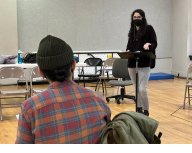
EJ Occupy workshop 476.JPG
Shekinah Lavalle, Linda Stettenbenz
and Nick Clark presented at an
Occupy Louisville teach-in.

Shekinah Lavalle, Nick Clark and Linda Stettenbenz – Jefferson County members of KFTC's Economic Justice Work Team – talked about the types of taxes used to support public programs and services, and how they affect people of different income levels.

They led one exercise in which participants named government programs and policies that have helped, or hurt, employment opportunities and wealth equality or disparity. After World War II, programs such as the GI Bill, a commitment to build an interstate highway system, and the strength of unions helped fuel the economy and move all income groups forward.

However, since 1979 a different set of policies – such as tax policies that favor corporations and the wealthy, union busting and deregulation – led to the stagnation of income growth for working families while accelerating wealth growth for upper-income folks.

Occupy participants Carol Smith and John Miller shared information on The Return to Prudent Banking Act, a Congressional effort to restore major provisions of the Glass-Steagall Act that were repealed in 1999. 

EJ Occupy workshop 491.JPG

The Glass-Steagall Act, also known as the Banking Act of 1933, was passed by Congress to prohibit commercial banks from engaging in investment speculation, according to information found at glass-steagallnow.com/. The removal of these controls had a lot to do with the collapse of banks and the economic crisis of 2008.

November-18-2011

Protections for Wilson Creek residents argued

The question of whether Laurel Mountain Resources should be allowed to mine on Wilson Creek in Floyd County without restrictions to protect the community was argued Friday before a three-judge panel of the Kentucky Court of Appeals.

The legal issue boiled down to whether the Kentucky Energy and Environment Cabinet Secretary overstepped his authority in ordering that any future mining on the land in question meet certain conditions.

The conditions were part of a February 2009 order, signed by Cabinet Secretary Len Peters, that denied a petition by Wilson Creek residents to declare 2,000 acres of their watershed as "unsuitable for mining."

Alex May
Alex May, representing the fifth generation
of his family from Wilson Creek, talks to
Associated Press reporter Dylan Lovan after
Friday's appeals court hearing.

However, the order did impose some conditions on any future surface mining on that land. Those conditions are:

  • The company cannot not use the one-lane Wilson Creek Road as its coal haul road;
  • Mined land has to be returned to its approximate original contour (this is already required by law but state officials routinely grant variances);
  • Trees have to be planted on the reclaimed land; and
  • Primary and secondary sediment control systems must be used to prevent flooding and control pollution.

Laurel Mountain Resources attorney W. Blaine Early III argued that state and federal laws related to "lands unsuitable" designations only allow the secretary to approve or deny such a petition, and not impose conditions if the petition is denied.

By doing so, Early argued, Peters violated state law which prohibits the cabinet from applying any standards more stringent than federal law.

However, Early acknowledged that the conditions do not prevent mining, and the cabinet could apply the same conditions in the permitting process, just not in response to a "lands unsuitable for mining" petition.

A "place by place" consideration of the impacts of mining would be more appropriate rather than one applied universally to all 2,000 acres, he said.

Attorneys S. Bradford Smock and Steve Sanders took a different view.

"If he [Peters] chooses not to designate, he can still impose conditions," said Smock, who was representing the cabinet. "The conditions are something he's always been able to do under both federal and state law."

Judge John Lambert questioned why the cabinet would not choose to apply conditions through the permitting process.

The lands unsuitable process is designed "to see the whole picture … and not meant to be a place-by-place designation," Smock replied.

Sanders pointed out that "there is substantial evidence that supports the conditions," in Peters' order. He noted that Wilson is already designated as an "impaired stream" by the Kentucky Division of Water, and that the hillsides already are prone to land slides.

Sanders was representing Wilson Creek resident Bev May and KFTC, parties to the original petition and defendants in a lawsuit brought by Miller Brothers mining, the company that originally applied for the strip mining permit. Miller Brothers' operations have since been taken over by Laurel Mountain Resources, a subsidiary of Richmond, Virginia-based James River Coal Company.

In September 2010, Franklin Circuit Judge Thomas Wingate upheld the cabinet's order. In the decision Judge Wingate wrote that "the court finds that there was substantial evidence to support the Secretary's determination that flooding could occur."

The mining plan included three valley fills, which would bury the headwaters of Wilson Creek and Big Fork.

Friday's hearing was an appeal of Wingate's ruling.

The judges did not indicate how soon they will rule on the case.

Wilson Creek satellite image

Wilson Creek satellite image