MTR
September-16-2008
Concerned citizens speak out against proposed mine at Poor Fork
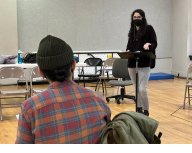
| KFTC members at the State's Permit Conference hearing at Oven Fork Senior Citizens Center Letcher County |
Nearly 30 concerned community and statewide residents, sportsmen, and KFTC members participated in a public permit conference hearing held the by State Department for Natural Resources, Thursday September 11th at the Oven Fork Senior Citizens center in Letcher County.
Under the Surface Mining Control and Reclamation Act (SMCRA) of 1977 residents have the right to submit public comments as the state is reviewing a coal company's mining permit application for official state approval.
Cumberland River Coal Company of Appalachia, VA has applied for a surface coal mining and reclamation operation permit affecting 1,299.25 acres of surface, constructing three hollow fills and five sediment ponds approximately 1.4 miles from the community of Eolia. The proposed operation would use the surface contour, area and highwall mining methods of surface mining along the Poor Fork of the Cumberland River near the Bad Branch Nature Preserve.
| Poor Fork area Letcher County proposed mining site near the headwaters of the Cumberland River |
The Poor Fork is one of the headwater streams for the Cumberland River and is one of only six Kentucky designated class 1 streams for its pristine water quality and natural brook trout population.
Residents protesting the proposed mining permit are concerned about the impacts to the headwater streams of the Cumberland River, their communities and the future of Bad Branch.
KFTC members gave testimony in favor of protecting the streams and requested that the state deny the mine permit.
Local resident KFTC member, Jim Webb, quoted the late Harry M. Caudill, "reclamation is like putting lipstick on a corpse, I don't want to see Black Mountain become a corpse."
Local artist and KFTC member, Jeff Chapman-Crane presented the state
with an analysis of Cumberland River Coal company's profit gains
according to information combined from the Associated Press and
Mountain Eagle reports published on July 30, 2008.
Cumberland River's parent company, Arch Coal Inc., reported that its second quarter profit tripled from $37.6 million in 2007 to $113 million in 2008.
But while Arch Coal officials and stockholders may be celebrating their profit margins the Appalachian region and its people are the one's who are paying the true cost of coal. We pay every time our homes are shaken off their foundations with each illegal blast the company sets off, the mountains pay one by one as they are blown up and made barren, and the streams pay into Arch's profits with each mile that is buried and contaminated."
Over the past 30 years jobs in the coal industry have decline significantly. Mean while the production of coal has increase and the price of coal has skyrocketed. This economic practice funnels more and more money to fewer and fewer people further jeopardizing our future.
--Jeff Chapman-Crane
Concerned citizens are awaiting for the state's decision to grant or
deny Cumberland River Coal's proposed mine permit.
There was general consensus that the next step for community action is to monitor the permitting process closely. Residents need to make sure that the company does not begin to mine without a permit or decide to clear the land without permission.
September-07-2008
Recent News on Coal, Energy and Mountaintop Removal Mining and Valley Fills
The following are news articles and blog posts about coal, mountaintop removal mining and valley fills, and energy from a regional, national and global perspective.
The Price of Central Appalachian Coal:
- According to the Federal Energy Information Administration the current spot market price for a short ton of central Appalachian coal is $140.
- Last year at this time the spot market price for a short tom of central Appalachian coal was $50.
Articles about Coal:
-
On July 31 of this year President Bush took held a meeting with the West Virginia Coal Association and Congressman Nick Rahall, and here is the transcript of what President Bush had to say.
This year-I mean, since we've been in office, we've spent $2.5 billion on clean coal research. Why? Because it's a good investment to make sure that an abundant supply of energy is available and is in use for a long time coming. That's why we're doing it.
- Unfortunately there always seems to be a series of coal mining accidents in China:
- Flood in Chinese coal mine traps 18 people
- Mine gas outburst toll rises to 13 in SW China
- 27 die in China coal mine blast
Articles about Mountaintop Removal Mining and Valley Fills:
- Word about Mountaintop Removal mining is spreading on college campuses. Here is an article from the University of Maryland's Student Newspaper.
The people of Appalachia have worked in the coal mines for decades. They've been the lifeblood of this country, and the reason our energy is cheap. Now they're being exploited for profit. This is the economic argument that says we should burn coal rather than use cleaner and more socially just alternatives, which would actually be the economic shot in the arm these people need. So much attention is focused on the pollution from burning coal that it's too easy for the casualties of its extraction to be swept under the rug.
Articles about Energy:
-
This is a good article comparing the permitting Carbo power-plant in south west Virginia in the late 1950's with the current fights around the permitting of the Dominion Virginia Power’s Virginia City power-plant.
Had I known what I know now, I think I would’ve protested, just because of the land and everything they took,” said Shirley Parrott Purcell, who grew up in this small Russell County community. (Referring to the Carbo power-plant built in the late 1950's)
-
Here is an article about a 100 million dollar pilot project in Germany to capture 100,000 tons of carbon dioxide a year from a coal fired power-plant, compress the carbon into a liquid and pump it 3000 feet underground. This will provide 12MW of electricity and 30MW of thermal power, enough for more about 1,000 homes. (That's about a million dollars per home. Sounds like an expensive electricity bill.)
-
In Albuquerque NM, PNM Plans Energy Future ; Renewables Fill In For Coal, Nuclear. The Albuquerque power company made this decision after anticipating that federal global warming legislation will make energy from coal very expensive in the future.
"We're very clear," PNM's Wheeler said. "No new coal." Likewise, nuclear power does not look like an economical option, though the PNM analysis holds open the possibility of changing that if electricity demand in New Mexico rises faster than anticipated.
September-04-2008
Court rejects state's water quality exemptions
Coalfield residents and all Kentuckians who like clean water got a partial victory Wednesday when the U.S. Court of Appeals agreed that the state’s practice of granting water quality exemptions is "arbitrary and capricious." The three-judge panel rejected 5 of 6 state exemptions, including a blanket exemption of coal mining discharges from “anti-degradation review.”
“We’ve long believed that the numerous exemptions in Kentucky’s regulations could seriously degrade water quality. The court opinion makes it clear that the Clean Water Act requires anti-degradation rules work to maintain water quality and EPA must look seriously at the individual and cumulative impact of … exemptions prior to approving them,” said Judith Petersen, executive director of Kentucky Waterways Alliance and the lead plaintiff in the case.
The 24-page opinion found that U.S. EPA's approval of five exceptions was "arbitrary and capricious" because EPA never required Kentucky to prove that the multiple exceptions would cause only insignificant degradation of the state's rivers, lakes and streams. The exemptions involve the use of public waters for storm water permits, sewage from single-family residents, waste disposal from industries and discharges from concentrated animal feeding operations.
The Court also rejected EPA's approval of Kentucky's blanket exemption of coal mining discharges from anti-degradation review. EPA approved this practice based on a letter from the state rather than a regulatory or statutory change that would have provided the public the right to comment on the rules.
We work diligently to protect our most important natural resource – water. And we’re delighted that the court stepped up to insist that mining be activities be held to the same standard as other permitted discharges,
KFTC Canary Project Fellow Teri Blanton
The legal action was filed under the “anti-degradation” provisions of the federal Clean Water Act. States are required to develop and implement rules to prohibit degradation of good water quality unless it is necessary to allow such degradation to accommodate important social or economic development. Kentucky developed plans that were rejected by EPA in 1997 and 2000. In 2005, given the absence of any approved state plan, KWA, KFTC and other plaintiffs sued the U.S. EPA asking that it be required to implement a plan for Kentucky. Shortly thereafter, EPA approved the state’s current draft of an anti-degradation plan. The plaintiffs then challenged specific parts of that plan.
While rejecting the exemptions, the Court upheld provisions on how Kentucky classifies streams (we wanted the state to have to consider more closely the impacts of individual pollutants).
The Court's opinion sends Kentucky's rules back to U.S. EPA for further review. Kentucky will likely have to significantly revise and improve its rules in order to comply with the Court's opinion.
Joining KWA and KFTC in the legal action were the Sierra Club Cumberland Chapter and the Floyds Fork Environmental Association. We were represented by the Environmental Law and Policy Center and the Kentucky Resources Council.
September-03-2008
KFTC at Worldfest
September-01-2008
H-L Op-ed: Mongiardo has wrong vision for Eastern Ky. mountains
Herald-Leader Op-ed
Mongiardo has wrong vision for Eastern Ky. mountains
By Rick Clewett
Read the complete Herald-Leader Op-Ed HereAl Fritsch, the founder of Appalachia Science in the Public Interest, published a book in 2003 titled Ecotourism in Appalachia: Marketing Our Mountains. In it, he and co-author Kristin Johannsen laid out alternate visions of the region some years hence.
One vision portrayed a region plagued by cheap, uninteresting and standardized development, unrestrained ATV use that tore up land and endangered people, and unrestrained mining that made the land ugly and ruined the streams.
In the positive vision, the book portrayed a region that was the beneficiary of small-scale, local economic development well-calculated to draw people to the region in a way that sustained the value and interest of the region while providing jobs for its inhabitants and enriching the minds and souls of all concerned.
Fritsch and Paul Gallimore published a sequel in 2007: Healing Appalachia: Sustainable Living through Appropriate Technology. The Cumberland Sierra Club wholeheartedly supports this vision of a unique and viable Eastern Kentucky.
Three of us Sierrans recently met with two members of Lt. Gov. Dan Mongiardo's staff to share our dream and our fears that irresponsible mining and ATV use will lead to a much less desirable future for Eastern Kentucky. We received a polite hearing, but little more.
Unfortunately, it is becoming clear that Mongiardo's dream is a system of ATV trails covering the state and that he is willing to use his political muscle to have his way. Herald-Leader reporter Andy Mead broke this story Aug. 21, and the paper said in its editorial the next day, "The public's interest is in enforcing the law to protect public and private property, not inviting more destruction..."
August-22-2008
What happened to Elmer's fishpond?
Here is the first of a series of Digital Stories that Alexa Mills, an intern from MIT that stayed in Whitesburg this summer, has produced for KFTC. This one is on Elmer Loyd's fishpond that was destroyed by mining in Harlan Co.
August-20-2008
Peabody CEO says "black is the new green"
This blog post was written by Beth Bissmeyer, a Berea College student and co-chair of the Madison County chapter.
While a good many folks reading this blog know that coal is far from clean, Gregory Boyce, Chairman and CEO of Peabody Energy--the largest privately-owned coal company in the world--wants you to think otherwise, and is willing to spend millions to convince you. In a USA Today article published Monday, it was reported that Peabody "kicked in about $9 million this year to an ad campaign touting 'clean coal.'"
Here's a kicker of a quote from Boyce:
There's a perception out there that coal is dirty, and we have to change that," he adds, noting that coal plants already have cut emissions of some pollutants and boosted efficiency to slash CO2 discharges. "Black is the new green."
The article goes on to cover Peabody's push for coal-to-liquid and how the rising demand outside the US has, in part, impacted coal supply and price. According to the article, "Prices for Appalachian coal have jumped from $45 to more than $100 a ton since last year. Citing soaring coal costs, dozens of utilities recently announced electricity rate increases of up to 30%."
And as people across Kentucky and across the US are facing increased utilities rates, Peabody and other coal companies continue to spend big. The USA Today article reports that, "About 30 coal-fired power plants are under construction around the country, the most in a generation. Peabody, along with partners, is building a $3 billion, 1,600-megawatt coal generator in Illinois, the biggest U.S. coal plant in 25 years."
TAKE ACTION!
We need to continue debunking the myth of clean coal and working to stop the building of new coal-fired power plants. A good letter to the editor always serves as a great way to have your voice heard, and if you felt so inclined, you could give Peabody your two cents, as well:
Peabody Energy
701 Market St.
St. Louis, MO 63101
314-342-3400
pr@peabodyenergy.com
Who is paying for the Political Party Conventions and what do they get for it?
That is the $112 million dollar question.
How much cash will it take to put on the biggest political bashes of the season – the Democratic Party Convention in Denver this August and the Republican Party Convention in Minneapolis this September?
Private donations (overwhelming from corporations) are expected to exceed $112 million, which should cover 80% of the convention costs according to a new study released today by the Center for Responsive Politics and the Campaign Finance Institute.
Unlike direct campaign contributions, contributions to the political party conventions are unlimited and come directly from corporate treasuries. The report also shows that these same corporate sponsors “have been heavily engaged in the struggle for federal political influence since the last Presidential election.”
These organizations have responded to solicitations from partisan elected officials and fundraisers dispatched by the host committees. These solicitors have dangled promises of access to grateful federal elected officials.
Among other industries listed as donors, mining and electric utility interests were included in the list of convention sponsors. Peabody Mining, Arch Coal, and Newmont Mining are all sponsors of the Democratic Party Convention in Denver. Edison Electric Institute, Southern Co, Tri-State Generation and Transmission Association, Xcel Energy, and Great River Energy are all electric utility organizations sponsoring one or both party conventions.
To view the complete report and listing of convention sponsors and also how much money they have spent on lobbying federal officials over the past three years, visit the Campaign Finance Institute website.
August-14-2008
Western Kentucky Chapter Insists on Answers
We arrived a bit early and took our seats spread out among the audience with a rough idea of the kinds of questions we wanted to ask. The governor started by introducing his wife and saying some words about the condition of the state. I was a little nervous when he opened the floor to questions, thinking my long hair and cut off shorts didn't belong in this room full of suits and patent leather
shoes.
Fortunately, the first question went to a man sitting right on front of me who brought a dossier full of information and news articles about mountain top removal named Steve Campbell. He asked several questions one would think no politician could get out of, but the governor figured out a way to answer Campbell's question by not saying anything at all. You might say that was the theme of the evening.
Governor Beshear answered question after question from concerned citizens asking for adequate funding of specific agencies, or for relief of their burdens. Finally Nick got called on and he asked a question about restoring voting rights to felons. Steve swung right through the pitch, merely recounting the process to restore voting rights to felons as it currently stands.
While we were very excited for the opportunity to speak truth to power, we weren't satisfied with the answers we got. We went to a show that night, but not before agreeing to follow the governor to Owensboro the following week to get the answer we deserved.
Only Nick and I could make it to Owensboro, but we were much better prepared. We wrote down exactly what we wanted to say, worked out where we wanted to sit, and who was going to ask our questions. This time the governor would have to address our question.
We asked him what he was going to do about the 186,000 Kentuckians who won't be able to vote in this year's vital presidential election, and why there isn't an amendment on the ballot, or why he won't even issue a blanket pardon. He started out with the same old procedural stuff from before, but by the end he said he wouldn't object if an amendment passed the legislature.
Afterwards, a legislative liason named Mark Mangeot came up and talked with us about the efforts of Jesse Crenshaw in Lexington around HB 70. Nick talked to the Secretary of Energy and Environment about MTR, but only received the same tired administration line of carbon capture and storage. Apparently, there was an engineer there as well who talked to the secretary about the implausibility about the idea of carbon capture and sequestration. It was really cool to share cycling stories with this 70-year-old engineer. People like him and Steve Campbell showed just how many people out there in the commonwealth have a vision a truly healthy Kentucky.
August-05-2008
H-L Column - Coal country needs outsiders' protection
Lexington Herald-Leader Column
Coal country needs outsiders' protection
by Larry WebsterRead the complete Herald-Leader Column HereMost politicians are like a man who went in a liquor store and asked them for a half-pint of Old Rabbit. ”We got Old Crow,“ said the clerk, ”but we ain't got no Old Rabbit.“
”Well,“ said the man, ”I didn't want to fly, I just wanted to hop around a little bit.“
Most politicians don't want to fly over Eastern Kentucky for the same reasons many victims of cheating don't tail their husbands. Most politicians look down on Eastern Kentucky, but certainly not from a plane. Gov. Steve Beshear has been taken to task for flying, but most of us think that if every single member of his administration were required to fly over every visible mile of coal country, it could turn out to be the best investment of money we ever had, unless of course the members of his administration align themselves anew with the mindless oafs.
The scale of it is what you see from the air. The totality of the destruction of one of the last beautiful places in the country being performed by an industry in death throes itself. In my county, 65,000 acres have been destroyed already, and there is not a single reason all the rest of our acres won't be also.
Those who choose to not just hop around but to really fly and really know are presented with stark personal choices that go to the heart of morality and stewardship of the Earth. They are eating of the apple of knowledge and now must choose right from wrong...