EKY
August-27-2010
Benham & Lynch tell DMRE Enough is Enough!
"Our water is worth more than that coal!” Bennie Massey said to the Kentucky Department of Mining and Reclamation Enforcement (DMRE) at Wednesday's hearing on the proposed strip mine for Benham & Lynch, Harlan County. Bennie, Lynch's longest running city council member, joined 20 of his neighbors and friends in Middlesboro at the DMRE to speak out against the 500-acre strip mine that will threaten the community's drinking water.

Allies from around the state supported these brave communities by answering a KFTC call to action made last week to contact KY Dept. of Natural Resources Commissioner Carl Campbell, telling him that enough is enough, respect the plans and concerns of local residents and give priority to protecting the communities' assets. Upon request from several residents at the hearing, the deadline for these comments has been extended. Click here to take action.
Along with water, residents of Benham and Lynch expressed several other fears about the proposed mine. “Mountains can't be destroyed and then expected to hold back water,” one woman explained after reading aloud an article about Pike County residents of Harless Creek suing a coal company for extreme flooding damage. “I have flood insurance right now and I live up on a mountain.”
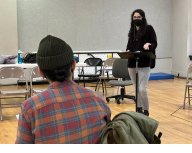
Stanley Sturgill (below) added, "I don't wanna be blasted out of bed every morning by those machines."

August-24-2010
The People Behind Coal in Colombia and Kentucky - post 3
Our goal was to explore the connections between the impacts of the coal industry in Kentucky and Colombia. An important part of the exchange and the high point for many was a celebration of culture and an exchange of the things that people in both places love about where they are from.
A delegation of 5 from Kentucky - including 3 KFTC members and 2 staff - participated in this Witness for Peace trip, which was focused on "The People Behind the Coal in Appalachia and Colombia." The exchange began with a tour of mountain communities impacted by coal mining in Eastern Kentucky. From July 19th to July 26th, the group traveled on to Colombia. We spent the week learning about the impacts of the coal industry on Colombian communities in a northern coastal region called Cesar.
In a village called Tamaquito, we sat under a cool canopy of trees in mud huts with palm thatched roofs. KFTC member Randy Wilson took a moment of space to do some pickin' for the villagers. People were immediately at ease, and the space filled with laughter and song.
Randy Wilson's Banjo in Tamaquito, Colombia from Kentuckians For The Commonwealth on Vimeo.
The villagers then performed a dance for us where the women, covered from head to ankle in flaming red capes, circled the open ground to the sound of a drum. Then one woman was joined by one man and they twirled together in an intense circle, rounding one another and bumping shoulders.
After the dance, the villagers fed us a rich meal of marinated rice and goat meat. We talked as much as we could with them and played with the children who ran all around us. It started to rain and we quieted, sitting under the shade and listening to the sounds of the drops in this beautiful little village. With only one solar panel in the village, no one went inside their homes during this pleasant afternoon rain, but sat watching, experiencing it instead.
When we asked the villagers what they loved about the place they call home, several of them smiled. One said, “When the sun sets and night falls it is dark, we know where we are. We are not lost. Once, we lived in peace here.”
Tamaquito is being forcibly displaced from their land by a coal mining company. We're losing communities and cultures like them around the world at a rapid clip, due to our driving demand to consume. As Randy Wilson said, "The very people who know how to live sustainably, who figured this out long, long ago, are being displaced by a society whose principles and policy don’t have a clue."
The hope we can find is in communities standing together to learn from one another and to protect the values, the culture and the possibilities of transition that still remain here in Kentucky and abroad.
To learn more about the issues and the trip, plan to attend KFTC’s Annual Meeting and participate in a multi-media presentation about the trip.
August-23-2010
Harlan County Fish Pond Hit Again by Mining
Nearly three years ago, Elmer Lloyd began a journey for justice on his property in Cumberland, KY after the Nalley & Hamilton owned strip mine above his home completely devastated his family's fish pond. Excessive drainage of toxins, sediment, and mud killed hundreds of fish and nearly filled in the entire pond, as shown by video footage here. Years of lawyers, inspectors, court battles, and coal company lies, ended in Elmer having to settle with the company.
“I fully believed there were enough laws to protect my property. Boy was I wrong.” Elmer, disabled underground coal miner, says of the tragedy. This past November Elmer received his small settlement and began a new journey to restore his pond. Since then he has spent nearly three thousand dollars on the restoration.
Late last week, the site above Elmer's home, now considered “reclaimed”, released another slide of silt and mud into his pond. “We had some rain, but the stream coming off Pine Mountain [onto my property] was crystal clear. The stream running off that strip job was thick mud running right into my pond.”
Inspectors came out but were resistant to give Elmer any information. They told Elmer they would be in touch about the water samples they took, and they couldn't write a violation if the company was in compliance.
“They probably won't give them an off permit violation because of all the mess I made about it the last time. They know I won't shut up about it and I'll stay right on 'em.”
Elmer is hopeful that this incident isn't as detrimental, although still very damaging. He is yet to find any dead fish, but it will take some work to fix it. If his pond takes a couple similar hits to this one, it will be right back to the destroyed state it was three years ago.
A lot of people around here have serious damage to their homes and property, but are scared to talk about it because them or their families work in the mines. I'm just a drop in the bucket, but I don't care to tell about it.
August-20-2010
Join KFTC's delegation to Appalachia Rising
Join KFTC's delegation to a conference and day of action focused on transition and the future of Appalachia. The events aim to advance
the dialogue about current energy extraction practices, with a specific
focus on ending mountaintop removal coal mining, and advocate for a
renewable energy future for Appalachia on a national stage
"We envision a vibrant weekend during which thousands will learn
about the challenges Appalachia faces and ways to build a movement to
end the destruction and plant the seeds of a sustainable and prosperous
Appalachia," said the organizers of the events.
The conference, entitled Voices from the Mountains, will be held on
September 25-26, 2010. Organizers of the Voices from the Mountain
conference are planning a space for regional participants to grow and
connect through strategy sessions, workshops, learning, and cultural
events. Topics will include both exploration of the issues facing the
region and ways to move forward.
The day following the
conference, September 27th, many people from the Appalachian region
will gather with conference attendees for a day of mobilization and
rallying on Capitol Hill. 2000 people, including movement leaders from
the region, celebrities such as Ashley Judd and Silas House, and many
Appalachian residents are expected to gather.
Click here to sign up or learn more.
August-09-2010
Broadband Internet Access to Expand in Rural Kentucky
Rural communities in Kentucky will see an expansion in their access to broadband internet service, thanks to $246 million in grant dollars that the state was just awarded last week. The grants are funded by the American Recovery and Reinvestment Act, also known as the federal stimulus package. These awards are a part of the federal government's long-term strategy to expand and improve internet throughout the country. (Visit http://www.broadband.gov/ to learn more about this.)
The recently awarded round of grants includes awards of more than $125 million in far west Kentucky, and more than $80 million in the mountains of eastern Kentucky. The eight funded projects outlined plans to build broadband infrastructure in unserved or underserved rural areas. The following is a list of the awards:
Leslie County Telephone Company - $6.1 million
Salem Telephone Company - $1.9 million
West Kentucky Rural Telephone Cooperative, Inc. - $123.8 million
Highland Telephone Cooperative, Inc. - $66 million
People's Rural Telephone Cooperative, Inc. - $25.5 million
Foothills Rural Telephone Cooperative Corporation, Inc. - $20.9 million
Windstream Corporation - $950,000
Mikrotec CATV LLC - $829,000
Kentucky had already received $75 million from this broadband infrastructure fund for projects in Grant, Owen, Morgan, Menifee, Wolfe and Elliott counties.
“Not only will this funding help create jobs, it will also help bring much-needed infrastructure to our rural communities, helping them to expand their services, attracting new businesses that will bring economic growth and jobs by providing affordable access to critical 21st Century technologies,” said Gov. Beshear.
Internet access will be key to factor in economic diversification in rural Kentucky, particularly in the eastern mountain communities. Broadband access facilitates small business-start ups and connects remote areas to larger market bases.
On a related note, KFTC allies at Appalshop are working on the issue of internet access and expansion with other groups. They want to ensure that the internet is affordable and accessible to all communities. The grassroots project, called Dial-Up Rocks, is based on these principles:
-Network Neutrality: Network neutrality (also net neutrality, Internet neutrality) is the principle of open and unfiltered access to the Internet, with no restrictions on content, sites, or platforms, the kinds of equipment that may be attached, or the modes of communication allowed.
-Universal Broadband: Universal broadband is a policy initiative to make affordable, high-speed broadband Internet affordable and accessible throughout the United States.
Free and unrestricted communication is a human right and that media is the intersection of power, social justice and all kinds of equity – gender, racial, and cultural. Media Justice is about taking control of our media environment – our airwaves, networks, and online spaces. To achieve this we must transform our relationship with media and how we want to define its structure and how our communities access media.
Dial-Up Rocks will be following the implementation of the broadband grants very closely.
August-03-2010
The People Behind Coal in Colombia and Kentucky - post 1
"Many social leaders refrain from publicly speaking out. As soon as they do, they'll become targets. They'll kill them. While telling you these stories puts the life of the person telling you at risk, it is important to get this information out. This can serve as a powerful denouncement of these activities in the U.S."
And maybe it can lead to change.
This from a human rights activist in a town called Cienaga just a few hours after our Witness for Peace delegation stepped off the plane in Colombia. In this meeting, we heard story after story of how a privately owned U.S. corporation named Drummond degrades the local community, abuses human rights and even has instructed its paramilitary forces to kill union leaders, according to community members. The message about the danger of speaking out would be echoed in nearly all the meetings we had with communities, unions and other local groups during the week.
Above (left to right): Cari Moore, John Capillo, Patty Tarquino, Nancy Reinhart, Randy Wilson
A delegation of 5 from Kentucky - including 3 KFTC members and 2 staff - participated in this Witness for Peace trip, which was focused on "The People Behind the Coal in Kentucky and Colombia." We spent the week learning about the impacts of the coal industry on communities in a northern coastal region called La Guajira.
Drummond Corporation, owned by Gary Drummond from Birmingham, AL, built a port in Cienaga about 20 years ago to ship the coal it mines to the U.S. and Europe. Drummond also purchased part of the Colombian national railroad, privatizing it to run coal.
Drummond Railway Drummond Port Barbed Wire Surrounding Port
The company now uses the railway to transport coal from its coal mine to its port, where long conveyor belts take the coal out into the sea and dump it onto barges. The port is guarded by a combination of private militia and national police and is surrounded by barbed wire. About 30 million tons of coal is exported from the port annually.
At the time of the port's construction, Drummond management promised the community that the port would yield prosperity for the people and employ local workers. Instead, community members say it is has polluted local waters with coal dust so fishing has become impossible, it has polluted the air with coal dust leading to many adults and children getting sick with rashes and respiratory problems, and it employs very few local people. The royalty monies that the mine pays are often stolen by corrupt politicians, leaving little of it invested in Cienaga community projects.
Randy Wilson, a Clay County KFTC member, responded to the stories he heard in this first meeting, saying, "It doesn't fit in my head how the U.S. – a country that preaches to the world about freedom – can step all over people here." He went on to draw parallels between the impacts of the coal industry on Colombian communities and workers and the industry's impacts in his home, eastern Kentucky.
A Cienega city representative and community activist mentioned his hopes for the future. "Our hope is in making the security situation better here so that we can organize. Our best hope is in community organizing."
Cari Moore, a Knott County KFTC member, left charged up to bring these stories back and affect change here in the U.S., in Kentucky and in Colombia.
"Injustice is everybody's business. It is so important that we show the connections [between Kentucky and Colombia], and show Colombians our reality. It is great to leave this on a note of hope, thinking about things we can do to help."
This is the first in a series of blog posts to come about the KFTC group's experience during this Witness for Peace tour in Colombia.
July-15-2010
More divide and conquer tactics from coal and WYMT
By KFTC member Silas House
Originally published in The Courier-Journal
Recently "an anonymous donor" paid for a sign to be made up and displayed at the Stonecrest Golf Course in Prestonsburg, Ky. The sign uses a photo of a semi-nude Ashley Judd that originally appeared on a 2006 cover of Marie Claire magazine. The caption beside the picture reads, "ASHLEY MAKES A LIVING REMOVING HER TOP. WHY CAN'T COAL MINERS?"
The sign is sexist, ignorant and infantile. The sign shows that the coal industry will stoop to any level to pit Appalachians against one another, and illuminates the fact that some people who support mountaintop removal will try to prop up their argument by misconstruing the facts and quotes.
Since Judd's speech on mountaintop removal mining aired, WYMT, the Hazard, Ky., news station (and a sister station of WKYT in Lexington) has repeatedly aired reports on the controversy brewing around her speech. Yet most of the controversy it's reporting on is being created by the station itself. All of its reporting has been incredibly biased. With its coverage of the sign, the reporting was not only biased, but sexist.
The sign came in response to a statement Judd made in a speech she delivered to the National Press Club in June about mountaintop removal, which she opposes. Her exact quote was, "I don't know a whole lot of hillbillies who golf." When put into context, it's clear that Judd is saying that true Appalachians cherish a mountain more than they do a golf course. And she's also pointing out that most MTR sites are not put to any use, despite a handful that have been used for things such as a prison and a golf course.
Much ado has been made of this quote. Those in favor of MTR have used it to say that Judd is using the word "hillbillies" in a negative connotation. They fail to point out that Judd starts the speech with these words: "Being an Eastern Kentuckian is the simple fact that brings me the most honor ... I ... am proud of being a hillbilly." They also say that her golf course quote is perpetuating a stereotype about Appalachians being backward. But they are misconstruing the quote and taking it out of context.
People who pass along this interpretation of the quote are doing exactly what the coal companies want them to do: they're perpetuating a lie and they're letting the importance of the issue get clouded up in something else.
The sign insinuates that Judd has made her career on taking off her clothes. Nudity is sometimes a part of acting, yes. But to imply that Judd has made her living off that is ridiculous. If George Clooney, another Kentuckian, had made the same speech, would they be putting up a sign about him taking off his clothes, since he, too, has appeared nude on film? Of course not. Because he's a man.
Lots of folks in Eastern Kentucky think that destroying the land is a lot more offensive than someone being naked. Yet the news seems to not know they exist, and certainly hasn't interviewed them.
WYMT furthered the sexism by only interviewing men during its report on the sign. The station refused to show the picture because it feared it "might be offensive to some viewers," implying the picture was vulgar instead of an artistic statement. It also threw in its own opinion with little nuggets like this: "We only found one person who thought the sign was a little over the top." That's blatantly leading the viewer/listener, and it's something that journalists are not supposed to do in this sort of report.
I believe everyone has the right to offer their opinion about MTR and Judd's speech, and I welcome differing voices. But twisting words and purposely taking things out of context is just flat-out wrong. It's lying.
When people and the media do this, however, they're doing just what the industry wants them to, as big corporations have always furthered their own causes by dividing and conquering the people. And when they do this they're simply illuminating to most intelligent folks that they don't have enough real facts to back up their argument that MTR is a good thing, so they resort to name calling and lying. That's just pathetic, and I hope more people will start seeing through these tactics.
July-13-2010
Ashley Judd Comments
Ashley Judd wrote the statement below in response to recent attacks from industry representatives on her public comments about mountaintop removal at a National Press Club Luncheon. Ashley is a KFTC member and spoke at the 2008 I Love Mountains Day.
I am proud to be standing with so many Eastern Kentuckians everywhere who are working to build a better future. There's so much potential today, right now, for Eastern Kentucky to proudly and bravely lead the way to a new energy economy in this country, with more jobs and more justice for the people of the Appalachian Mountains. It is time for a community abused and exploited by outsiders who have never had our best interests at heart to rise and lead our entire country into a renewable energy future. We can and do have the hope and the vision to bring real, diverse jobs, money, health, and generativity that benefits the broader common welfare. The cost of premature mortality related to coal mining in Eastern Kentucky was 3.1 to 6.2 billion every year. Kentucky's annual net loss related to coal mining is $115 million per year. This must stop.
When I started speaking out about mountaintop removal, I expected to be attacked personally. I told my husband we should be prepared for it, because the coal companies are cunning, callous and greedy. They use people on the ground as their front, and pit us against one another. However, I know the derogatory and defamatory comments directed at me absolutely pale in comparison to what it is like for those who live every day in the war zone created by mountain top removal mining in our beloved communities and mountains.
Thus, rest assured, I will continue to speak out about the many reasons I’m so proud to be from Eastern Kentucky for so many generations, and also about the things I think can be better. I stand with those whose jobs are lost by increased mechanization, and those who are a terrified to lose the coal jobs they do have, because coal does not allow for other local economies. I stand with those whose land has been stolen from them, whose homes' foundations are cracked and whose water runs orange and black. I stand with those are sick from particulate dust and pervasive environmental toxicity related to MTR. I stand with those who grieve dead loves ones, killed on dangerous mining sites, by fly rock, by overloaded coal trucks, by social problems such as addiction related to the despair this mono economy wreaks. I stand with those who grieve the 800 mountains gone forever, the 2,500 miles of stream buried. I stand with those who believe we do not have to choose between mountains and jobs, our past and our future. I even stand with those who oppose me. I believe we can work together.
I look forward to the chance to have a real conversation, a civil conversation, as we retire the cynical and superficial coal company-created argument that we must choose between people and mountains. That is simply false, fear based and fear mongering. The time has come for Appalachia to have a dynamic, diverse economic base that actually supports and perpetuates our inherent richness, rather than destroying and depressing it.
KFTC is proud to stand with Ashley and people from Eastern Kentucky who are working to build a better future in the region. There is great potential right now for Eastern Kentucky to help lead the way to a new energy economy in this country, with more jobs and more justice for the people of the Appalachian Mountains. Talking together in a civil, honest way about how we'll get there given the very serious issues we're facing today is the start of a real solution.
June-10-2010
Ashley Judd Speaks About Protecting the Mountains of Appalachia from Mountaintop Removal Coal Mining
"Ashley Judd talked about the practice of mountain top removal coal mining, a form of strip mining. Ms. Judd, a Kentucky native, has long been outspoken about the need to this mining method. As part of this effort, she has partnered with the Natural Resources Defense Council and other environmental groups to raise national awareness of the problem and to inspire others to join the fight to end mountaintop removal." From C-SPAN's website.
May-13-2010
UPDATED: A Bill To Help Rural Residents Finance Energy Efficiency Improvements Considered at Federal Level
An important step to achieving a clean and economically viable future for rural electric cooperatives, their member-customers, and their local economies will be the establishment of “on-bill financing” programs which will help overcome the up-front costs of implementing energy efficiency and weatherization measures.
The Rural Energy Savings Program Act
(S. 3102 / H.R. 4785)
On March 10, 2010, the Rural Energy Savings Program Act was introduced in Congress. The bill was introduced in both the House and the Senate with bipartisan support.
Under the new program proposed by the bill, the US Department of Agriculture’s Rural Utilities Service (RUS) will create a $4.9 billion loan program available to cooperatives with a zero percent interest rate. Cooperatives in turn will make this money available to consumer members in the form of micro-loans with an interest rate of no more than 3 percent, which can be paid back primarily through savings on their electric bills. This type of loan program is called “on-bill financing” because the loan payments would be made right on the utility bill. Another key component is that the loan would stay with the real property (i.e. the electric meter) rather than with the utility customer.
Bipartisan co-sponsors of the Senate version of the bill (S. 3102) include Senators Jeff Merkley (D-OR), Lindsey Graham (R-SC), Richard Lugar (R-IN), Jeanne Shaheen (D-NH), Tim Johnson (D-SD), and Michael Bennett (D-CO).
A companion bill in the House of Representatives (H.R. 4785), was introduced by Representatives James Clyburn (D-SC), Tom Perriello (D-VA), Ed Whitfield (R-KY), and John Spratt (D-SC).
Why this bill is important and its implications for Appalachia
The East Kentucky Power Cooperative (EKPC) is a non-profit electric utility that provides power to 16 rural electric cooperatives across 87 Kentucky counties and is currently in the permitting process for the proposed construction of a new coal‐burning power plant in Clark County, KY, called the Smith plant. About half of the counties served by EKPC are in Appalachia, and about a quarter are coal-producing counties. Many of these are some of the most economically distressed counties in the nation.
A recent report commissioned by Kentuckians For The Commonwealth, Kentucky Environmental Foundation, and the Cumberland Chapter of the Sierra Club found that an investment in a combination of energy efficiency, weatherization, hydro-power and wind power initiatives in the region would generate more than 8,750 new jobs for Kentucky residents, with a total impact of more than $1.7 billion on the region’s economy over the next three years. This alternative approach would meet the energy needs of EKPC customers at a lower cost than the proposed coal plant.
Federal and state policies that make possible on-bill financing for the energy efficiency and weatherization portion of the alternative are important steps toward a clean energy future for EKPC co-ops and their members. Passage of the Rural Energy Savings Program Act is integral to this future, and the jobs and positive economic impact it will bring.
____________________________________
UPDATE: As of May 12, bill now has 15 co-sponsors for the Senate version. And the House version is now co-sponsored by four of Kentucky's six representatives: Rep. Ed Whitfield (KY-1), Rep. Ben Chandler (KY-6), Rep. Hal Rogers (KY-5), and Rep. Brett Guthrie (KY-2).
Also, we should mention that on the state level, the Mountain Association for Community Economic Development (MACED) is working on a pilot of the on-bill financing idea with four distribution co-ops in eastern Kentucky. MACED and those co-ops are waiting for Public Service Commission approval but are currently working together to get the systems in place to provide on-bill financing options to co-op members.

Click here for news about recent mine disasters.