DC
March-09-2010
End Mountaintop Removal Week in Washington Report #2
The ring from a bell means so much during Week in Washington...it means that another legislator has stood up to big coal and decided to co-sponsor the Clean Water Protection Act
We just got another co-sponsor ! We are now up to 166!
Week in Washington Bell Ringing from Kentuckians For The Commonwealth on Vimeo.
End Mountaintop Removal Week in Washington Report #1
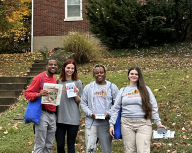
More than 20 KFTC members and staff have traveled to Washington, D.C. to participate in the End Mountaintop Removal Week in Washington sponsored by Appalachian Voices and the Alliance For Appalachia. In D.C. we are joined with more than 200 other community activists and coalfield residents representing 27 different states.
We traveled to Washington to lobby for H.R. 1310, the Clean Water Protection Act and S.696, the Appalachia Restoration Act. Starting today through Thursday, March 11 we will be meeting with Representatives and Senators to help educate them about both pieces of legislation, and to also gain as many more cosponsors as possible.
Just partially through day one we have already gained two new cosponsors.
Members will continue to meet and lobby with legislators and different governmental agencies over the next few days.
Today is a national call-in day to end mountaintop removal
|
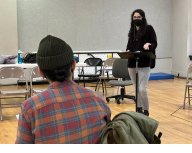
| Members from KFTC and other member groups in the Alliance for Appalachia lobbying in DC this week |
We need your help to bring an end to mountaintop removal coal mining. Join us today as part of a national day of action to end mountaintop removal coal mining.
This week, nearly 200 citizens from Appalachia and across the US are gathering in our nation's capital as part of the 5th Annual End Mountaintop Removal Week in Washington – and hundreds more will show support by making a simple phone call.
Mountaintop removal coal mining is one of the most egregious environmental and social justice disasters in America today -- more than 500 mountains and 1.5 million acres of land have already been destroyed by this practice. Residents and supporters from across the US are asking for an end to mountaintop removal and an investment in sustainable economic alternatives for Appalachia.
This issue is urgent and the coal industry is working overtime to block the passage of this bill. That's why we need people like you to take a stand for the mountains.
Please take a moment to visit www.ilovemountains.org/call-your-rep -- we have a special call-in tool there that will allow you to make a phone call to your Representative - if you've never called your Congressperson before - this is the easiest way to do it! We'll walk you through the steps and help you know exactly what to say.
Thanks for taking action - because of people like you, we're as close as we ever have been to ending mountaintop removal.
December-03-2009
Breaking News: Senator Byrd Calls on Coal Industry to Enbrace Change
In an recorded audio opinion piece just released by Senator Byrd, he does some truth telling about environmental concerns about coal and the rising tensions in coalfield communities with regard to mountaintop removal mining. He calls on environmentalist to recognize that coal produces half of the electricity in the demand in the U.S. and that coal will continue to be a part of our energy future. However, at the same time calls on the coal industry (and I would add coalfield politicians) to stop the divisive and dangerous rhetoric. He says there is bipartisan support in congress to end mountaintop removal mining.
If you appreciate Senator Byrd's opinion, give his office a call to say thank you.
202-224-3954
12/03/2009
'Coal Must Embrace The Future'U.S. Senator Robert ByrdWashington, D.C. |
(The following text is an opinion piece U.S. Senator Robert Byrd issued on Thursday. It appears below in its entirety.) Click here if you want to list to the audio version from Senator Byrd.
For more than 100 years, coal has been the backbone of the Appalachian economy. Even today, the economies of more than 20 states depend to some degree on the mining of coal. About half of all the electricity generated in America and about one quarter of all the energy consumed globally is generated by coal.
Change is no stranger to the coal industry. Think of the huge changes which came with the onset of the Machine Age in the late 1800’s. Mechanization has increased coal production and revenues, but also has eliminated jobs, hurting the economies of coal communities. In 1979, there were 62,500 coal miners in the Mountain State. Today there are about 22,000. In recent years, West Virginia has seen record high coal production and record low coal employment.
And change is undeniably upon the coal industry again. The increased use of mountaintop removal mining means that fewer miners are needed to meet company production goals. Meanwhile the Central Appalachian coal seams that remain to be mined are becoming thinner and more costly to mine. Mountaintop removal mining, a declining national demand for energy, rising mining costs and erratic spot market prices all add up to fewer jobs in the coal fields.
These are real problems. They affect real people. And West Virginia’s elected officials are rightly concerned about jobs and the economic impact on local communities. I share those concerns. But the time has come to have an open and honest dialogue about coal’s future in West Virginia.
Let’s speak the truth. The most important factor in maintaining coal-related jobs is demand for coal. Scapegoating and stoking fear among workers over the permitting process is counter-productive.
Coal companies want a large stockpile of permits in their back pockets because that implies stability to potential investors. But when coal industry representatives stir up public anger toward federal regulatory agencies, it can damage the state’s ability to work with those agencies to West Virginia’s benefit. This, in turn, may create the perception of ineffectiveness within the industry, which can drive potential investors away.
Let’s speak a little more truth here. No deliberate effort to do away with the coal industry could ever succeed in Washington because there is no available alternative energy supply that could immediately supplant the use of coal for base load power generation in America. That is a stubborn fact that vexes some in the environmental community, but it is reality.
It is also a reality that the practice of mountaintop removal mining has a diminishing constituency in Washington. It is not a widespread method of mining, with its use confined to only three states. Most members of Congress, like most Americans, oppose the practice, and we may not yet fully understand the effects of mountaintop removal mining on the health of our citizens. West Virginians may demonstrate anger toward the Environmental Protection Agency (EPA) over mountaintop removal mining, but we risk the very probable consequence of shouting ourselves out of any productive dialogue with EPA and our adversaries in the Congress.
Some have even suggested that coal state representatives in Washington should block any advancement of national health care reform legislation until the coal industry’s demands are met by the EPA. I believe that the notion of holding the health care of over 300 million Americans hostage in exchange for a handful of coal permits is beyond foolish; it is morally indefensible. It is a non-starter, and puts the entire state of West Virginia and the coal industry in a terrible light.
To be part of any solution, one must first acknowledge a problem. To deny the mounting science of climate change is to stick our heads in the sand and say “deal me out.” West Virginia would be much smarter to stay at the table.
The 20 coal-producing states together hold some powerful political cards. We can have a part in shaping energy policy, but we must be honest brokers if we have any prayer of influencing coal policy on looming issues important to the future of coal like hazardous air pollutants, climate change, and federal dollars for investments in clean coal technology.
Most people understand that America cannot meet its current energy needs without coal, but there is strong bi-partisan opposition in Congress to the mountaintop removal method of mining it. We have our work cut out for us in finding a prudent and profitable middle ground – but we will not reach it by using fear mongering, grandstanding and outrage as a strategy. As your United States Senator, I must represent the opinions and the best interests of the entire Mountain State, not just those of coal operators and southern coalfield residents who may be strident supporters of mountaintop removal mining.
I have spent the past six months working with a group of coal state Democrats in the Senate, led by West Virginia native Senator Tom Carper (D-Del.), drafting provisions to assist the coal industry in more easily transitioning to a lower-carbon economy. These include increasing funding for clean coal projects and easing emission standards and timelines, setting aside billions of dollars for coal plants that install new technology and continue using coal. These are among the achievable ways coal can continue its major role in our national energy portfolio. It is the best way to step up to the challenge and help lead change.
The truth is that some form of climate legislation will likely become public policy because most American voters want a healthier environment. Major coal-fired power plants and coal operators operating in West Virginia have wisely already embraced this reality, and are making significant investments to prepare.
The future of coal and indeed of our total energy picture lies in change and innovation. In fact, the future of American industrial power and our economic ability to compete globally depends on our ability to advance energy technology.
The greatest threats to the future of coal do not come from possible constraints on mountaintop removal mining or other environmental regulations, but rather from rigid mindsets, depleting coal reserves, and the declining demand for coal as more power plants begin shifting to biomass and natural gas as a way to reduce emissions.
Fortunately, West Virginia has a running head-start as an innovator. Low-carbon and renewable energy projects are already under development in West Virginia, including: America’s first integrated carbon capture and sequestration project on a conventional coal-fired power plant in Mason County; the largest wind power facility in the eastern United States; a bio-fuel refinery in Nitro; three large wood pellet plants in Fayette, Randolph, and Gilmer Counties; and major dams capable of generating substantial electricity.
Change has been a constant throughout the history of our coal industry. West Virginians can choose to anticipate change and adapt to it, or resist and be overrun by it. One thing is clear. The time has arrived for the people of the Mountain State to think long and hard about which course they want to choose.
December-02-2009
Live Internet Chat with Members of Obama's Cabinet
This comes to us thanks to the great work being done by the folks at the Energy Action Coalition and PowerShift.
Today is our opportunity to speak directly to President Obama's team before he heads to the Copenhagen climate negotiations next week! Young leaders from across the movement have gathered in Washington DC, and we will spend the day preparing to tell EPA Administrator Lisa Jackson, Secretary of Energy Steven Chu, Secretary of the Interior Ken Salazar and Secretary of Labor Hilda Solis that we need bold, just and immediate action on climate and energy.
We need your voices in the room. You can join the forum today from 4pm - 7pm EST by watching the LIVE webcast at www.whitehouse.gov/LIVE or by providing comments and questions on the LIVE Facebook Chat at http://apps.facebook.com/whitehouselive/. Remember to write blog posts and tweet them to @PowerShift09 with the Youth Clean Energy Forum's official hashtag: #YCEF. You can also watch a live feed of the twitter conversation at www.powershift09.org.
Congratulations on this big day for the youth climate movement and please join us this afternoon!
Whit Jones
Acting Field Director
Energy Action Coalition
Energy Action Coalition is a youth-led coalition of 50 organizations working together to fight for a clean, just and renewable energy future. Join the new Local Community and get your neighborhood involved in the national push for a future powered by clean energy and not by dirty politics.
For a list of Energy Action Coalition partners, please visit our Energy Action Partners page.
November-30-2009
OSM Seeking Sugestions from Public on Changes to Stream Buffer Zone and Approximate Original Countour Rules
This is the federal Office of Surface Mining collecting comments from the public on how OSM might change the Stream Buffer Zone and Approximate Original Contour rules and to the extent possible the comments should also incorporate scientific evidence to support the suggested changes.

Today, Monday November 30th, the Federal Office of Surface Mining Reclamation and Enforcement (OSM) took a first step to clarify how they will improve their protection of streams and also clarify the rules around returning a mined area to it’s Approximate Original Contour (AOC). This first step is really just OSMRE gathering public opinions around how OSM should improve their protection of streams and the rules around returning mined areas back to AOC. So to be clear, this is not the OSM requesting comments on a proposed change to either the Stream Buffer Zone rule or the Approximate Original Contour rule. This is OSM collecting comments from the public on how OSM might change these rules and to the extent possible OSM would like the comments to incorporate scientific evidence to support the suggested changes.
You can download the federal notice here.

All of these changes are building off of the Memorandum of Understanding developed on June 11th of this year between the Environmental Protection Agency, the Department of the Interior (which administers OSM) and the Army Corps of Engineers. This Memorandum of Understanding is a road map for how these three government agencies will relate to each other as they improve their communication when evaluating and issuing coal mining permits.
Part of the Memorandum of Understanding said that the Obama Administration would through the legal system have the 2008 Bush Administration changes to the Stream Buffer Zone rule thrown out. However, this summer the courts rules against the Obama administrations efforts and said that if the Obama administration wanted to change the 2008 Bush administration’s Stream Buffer Zone rule change then they needed to go back through the long administrative process for such rule changes.

You can get a more detailed history of the Stream Buffer Zone rule by reading the history section of the Federal Registry, but essentially the 1983 Stream Buffer Zone rule said the coal companies were not allowed to mine within 100 feet of a perennial or intermittent stream unless they could show that their mining “would not violate State or Federal water quality standards and would not adversely affect the water quantity, quality or other environmental resources of the stream.”
The 2008 Bush administration changes did require coal companies, to the extent possible, to minimize the damage to streams when mining within the 100 foot Buffer Zone, but they also exempted certain activities from the Buffer Zone requirements such as if a stream will cease to exist in its original location as a result of the mining activity. These activities include “stream-channel diversions, construction of stream crossings, construction of sedimentation pond embankments, and construction of excess spoil fills and coal mine waste disposal facilities.”
As for the requirement that coal companies return the land to it’s Approximate Original Contour as a part of the surface mining reclamation, this has never been clearly defined. Just how much of the mine waste dirt and rock needs to be put back onto the mine site? And in Kentucky AOC does not take into consideration elevation. So a coal company can take a mountain down 300 or 500 feet but as long as the original angle from the streambed to the top of the mountain, or slope of the side of the mountain, is “approximately” maintained then for reclamation purposes the mine has achieved their AOC requirements. Meanwhile the mountain is 300 or 500 feet lower.
In 1999 OSM did a study on AOC here in Kentucky, you can read about their findings here.

If more of the waste rock and dirt were required to be placed back on the mine site and if the coal company were required to match the original elevation then less of the waste dirt and rock would be dumped over the side of the hills and into the streams below.
Here is what the federal register says about submitting comments:
DATES: To ensure consideration, we must receive your comments on or before December 30, 2009.
ADDRESSES: You may submit comments by any of the following methods, although we request that you use the Federal e-rulemaking portal if possible:
• Federal e-Rulemaking Portal: http://www.regulations.gov. The document has been assigned Docket ID: OSM–2009–0009. Follow the online instructions for submitting comments.
• Mail, hand-delivery, or courier to: Office of Surface Mining Reclamation and Enforcement, Administrative Record, Room 252–SIB, 1951 Constitution Avenue, NW., Washington, DC 20240. Please include the Docket ID (OSM–2009–0009) with your comment.
September-16-2009
KFTC Members Help Brief Congressional Staffers
KFTC member Mickey McCoy joined allies from the organization Appalachian Voices, J.W. Randolph and Dr. Matt Wasson, on Capitol Hill Wednesday to brief advisors to members of the House Committee on Transportation and Infrastructure on the ravages of mountaintop removal mining in Appalachia and the critical need to immediately pass the Clean Water Protection Act (H.R. 1310). The briefing was held in one of the committee’s hearing rooms on Capitol Hill while McCoy and fellow Kentuckians Carl Shoupe, Carrie Traud and Rick Moore, was in Washington lobbying House and Senate members on H.R. 1310 and it’s companion Senate Bill, the Appalachia Restoration Act (S.696).

McCoy told staffers what it was like to live with mountaintop removal in Martin County, where nearly 25% of the land surface has been mined. Mickey told the audience,
"Mountaintop removal is an assault on the Appalachian Mountains, its people, their environment, and generations to come.
Mickey went on to share with them the day-to-day and long term impacts of mining, from the clear-cutting and blasting to the contaminated waters and dust to the persistent poverty and poor health that can be found wherever coal is carved from the Earth, clearly pointing out that his experiences were shared by thousands of others throughout the coal fields of Appalachia.
Dr. Matt Wasson provided those attending with an overview of Appalachian surface mining, pointing how widespread the destruction has become and emphasizing that our nation’s energy needs can easily be met without sacrificing the land and people of Appalachia. Wasson assured the Congressional staff members, representing both parties, that there has never been a time when ending mountaintop removal was more critical or more within our reach.
Toward the end of the briefing McCoy told the audience,
"It is not right for our government to allow the dismantlement of and entire culture for the sake of the greed of the coal corporations."
H.R. 1310 current has 156 co-sponsors from every region of the country, including Rep. John Yarmuth and Ben Chandler of Kentucky. An initial hearing on the bill may be held in Transportation and Infrastructure’s Water Resources Subcommittee as early as this fall.
June-25-2009
U.S. Senate committee to hear testimony on mountaintop removal. Watch it online.
More than 60 Appalachian coalfield residents are in Washington DC at this moment waiting for the start of the Senate committee hearing on mountaintop removal. The 3:30 p.m. EDT hearing before a subcommittee of the Senate Public Works Committee will look specifically at the impacts of water quality resulting from this practice.
A KFTC delegation is part of the group gathered. They spent yesterday and last night helping prepare personal stories and data for committee members. They also were excited to receive supportive statements from Kentucky members in the U.S. House, Reps. John Yarmuth and Ben Chandler.
Click here to watch the hearing online.