Entries For: June 2011
June-29-2011
Call on Rep. Hal Rogers to make better choices!
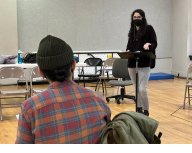
"The U.S. is one of the richest nations in the world. We can do so much better than this," said a participant at a recent tax justice workshop. She was wondering at the impact of the extreme cuts in funding that Rep. Hal Rogers (who chairs the U.S. House Appropriations Committee) has recently proposed for some of the brightest and most effective programs of our federal government.
Since April, the House Appropriations Committee has been developing s series of
twelve bills that, if passed, would unravel much of the progress that we've made toward our shared national goals and priorities. These bills propose budget cuts – cuts to farm programs, programs for children, and programs to help families save money on their electric bills – that would impact all of us, and especially all Kentuckians. And yet, many Kentucky legislators are playing a key role, especially Rep. Hal Rogers.
In an ongoing effort to keep Kentuckians informed and able to speak out, here are four examples of those cuts:
- Rep. Rogers proposes cutting the Department of Agriculture's Women, Infants, and Children program. WIC gives states federal grants to make sure that
low-income pregnant and breastfeeding women and babies under
five years old get nutritional support. If Rep. Rogers' plan is passed, estimates are that between 300,000 and 450,000 eligible mothers and their babies will be turned away from WIC next year, including between 4500 and 6800 Kentucky mothers and children. In Kentucky, where about one-quarter of our children are living in poverty, the potential impact of this cut--on families, on children, on local economies, on our state's ability to move forward, and especially in Rep. Rogers' own district--is staggering.
- The cost of the cuts to WIC are equivalent to the cost of extending the Bush tax cuts for millionaires alone for just one week.
- Other cuts within the Department of Agriculture will impact Kentucky, as well. Community Farm Alliance is analyzing cuts to programs that help local farmers and sustainability. Twenty-percent cuts to the Emergency Food Assistance Program will have a significant impact on our already-stretched food banks and pantries. The bill also cuts funding to the FDA, which supplies any safeguards to protect our food supply. Other cuts will obliterate the first new nutritional standards in 15 years proposed for
school breakfasts and lunches. According to a Washington Post article, "the lawmakers say meals containing more
fruits and vegetables, whole grains and low-fat dairy will cost an
additional $7 billion over five years — money they say the country can
ill afford in difficult economic times." How will our kids be impacted by this?
- Rep. Rogers' bill cuts 40 percent from what the Obama administration requested for the Department of Energy's Office of Energy Efficiency and Renewable Energy. This includes programs to develop renewable energy, a more energy efficient infrastructure, and programs that help low-income families weatherize their homes. These programs support the transition to clean and affordable energy options, which has created enough momentum to be the fastest-growing job sector in the U.S. Meanwhile, Rogers' plan offers the Office of Fossil Fuels more money than it even requested.
Together, we've worked hard to put good policies in place that move our nation forward. We can see the good impacts of child nutrition programs, for example, and of putting safeguards in place to protect our food supply. Now is our time to speak out for continuing our progress together, and to speak out against these harmful budget cuts to some of our brightest and most effective federal programs. We encourage Kentuckians to take every opportunity to speak out. Rep. Rogers is expected back in Kentucky in August, and a contingent of KFTC members will certainly try to meet with him then, and encourage you to do the same. There will likely be other opportunities for Kentuckians to communicate their thoughts about his work over the summer, too, and we'll try to keep you aware of those. You can also speak out today...
Take Action!
1) Write a letter to the editor of one of the state or local papers!
This is a great way to help people learn about Rep. Rogers' proposals, especially since they've been so under-reported. Here's a list of Kentucky's papers, with links to their websites. Most of them let you submit a letter online. And here is a link with tips on writing those letters. Feel free to borrow all you like!
2) Call your Congresspeople!
They need to hear from you. Not only about these cuts to some of the most necessary functions of our federal government, but also about your support of good revenue solutions like the Fairness in Taxation Act. Like that workshop participant said, "The U.S. is one of the richest nations in the world. We can do so much better than this." You can find the contact information for your representatives here, and the contact information for Sen. McConnell and Sen. Paul here.
June-28-2011
Coal companies continue to pollute, citizens act
Two coal companies operating in eastern Kentucky continue to routinely and illegally discharge toxic pollutants into local streams, including streams used by several towns for their drinking water supply.
“The sheer number of very serious pollution violations we found in the first three months of 2011 is astounding,” said Donna Lisenby, the director of Water Programs for Appalachian Voices, which compiled public records that document the pollution. “It shows a systemic and pervasive pattern of ongoing water pollution problems with no meaningful enforcement by Kentucky Energy and Environment Cabinet officials, who continue to sit idly by and let coal companies get away with thousands of violations.”
The companies self-reported the violations to the Kentucky Energy and Environment Cabinet. State officials have taken no action to stop the illegal discharges.
Documents released today as part of a new enforcement initiative by Appalachian Voices, Kentucky Riverkeeper, Waterkeeper Alliance and KFTC listed more than 1,400 pollution limit violations by the International Coal Group (ICG), and more than 2,800 violations by Frasure Creek Mining at its operations in eastern Kentucky in the first three months of 2011
The violations included average monthly total suspended solids (TSS) levels that were up to 15 times higher than allowed by the permit, average monthly manganese and iron levels that were than 3-10 times higher than allowed, the daily maximum for iron up to 13 times higher than allowed, as well as numerous pH, alkalinity and acidity violations.
“These violations represent a toxic soup being poured into our drinking water and streams,” said Ted Withrow, the retired Big Sandy Basin Management Coordinator for the Kentucky Division of Water and a KFTC member. “A recent peer-reviewed study shows a strong correlation between mountaintop removal mining and a 42% increase in infant deformities and other health effects. We now have proof we are killing children because of lax enforcement. Governor Beshear must step in and stop these outlaws from harming the unborn.”
![]() |
| Testing poisoned streams in Floyd
County with U.S. EPA officials. |
The four groups plus several individuals sent 60-day Notices of Intent to Sue to the two companies today.
This is similar to action the groups took last October when they threatened to sue ICG and Frasure Creek for 20,000 Clean Water Act violations. That prompted Kentucky Energy and Environment Cabinet officials to take industry-friendly actions to short-circuit the potential citizen lawsuits. With a light slap on the wrist, the officials proposed a settlement with the two companies, citing only 2,765 violations of the Clean Water Act and proposing fines of just $660,000.
One of the arguments they used to justify the small number of violations and low penalties was that many of the violations were merely “transcription errors,” not violations of pollution limits, and therefore did not warrant higher fines. At the end of the negotiation process, the cabinet officials proudly proclaimed that the proposed settlement would remedy the ongoing problems with these two companies. Today’s filing proves otherwise.
“These new violations show two things,” said Scott Edwards, director of Advocacy for Waterkeeper Alliance. “First, it exposes the cabinet’s deal with the coal companies for the ineffective, choreographed sham we always knew it was, and second, it shows that it is almost certain that all those 'transcription errors' the cabinet relied on to soft-pedal its settlement approach were really pollution discharge violations disguised as reporting errors."
"These are serious ongoing violations of the law," added Withrow.. "Cabinet should not step again to shield these companies it would be waste of taxpayers’ money, and money the cabinet does not have to spare. These coal companies do not require taxpayer protection."
Under the Clean Water Act, the companies have 60 days to respond to the allegations made in the notice letters. If, at the end of that period, all violations have not been corrected, the groups and individuals will pursue citizen enforcement, which can include filing a complaint in federal court. The plaintiffs are being represented by Mary Cromer with the Appalachian Citizens' Law Center, Lauren Waterworth of Boone, North Carolina, Burke Christensen of Richmond, Kentucky and the Pace Environmental Litigation Clinic in White Plains, New York.
Resources:
Media Coverage
- Ronnie Ellis story for the Community Newspaper Holdings
- Erica Peterson on WFPL-FM
- Matt Wasson on the Front Porch Blog
- Living on Earth by Jeff Young
- Facing South
- Dylan Lovan for the Associated Press
June-23-2011
Members ask Attorney General to help enforce the law
A group of KFTC members met with Chief Deputy Attorney General Patrick Hughes today to ask that he and Attorney General Jack Conway help enforce water protection and coal mining laws.
They made the request because the agencies responsible for enforcing these laws refuse to do so.
![]() |
| Rick Handshoe, Sue Tallichet and Megan Naseman wait in the state capitol for Gov. Beshear. |
That case was made by Floyd County member Rick Handshoe, who provided Patrick with a 10-page booklet that documented the pattern of non-enforcement. The group also gave Patrick a copy of a research report released Tuesday that showed a higher frequency of birth defects in areas where mountaintop removal takes place.
Earlier in the day,the group grabbed a minute with Gov. Steve Beshear after an unrelated press conference. They also provided him with copies of the two documents.
Reporter Ronnie Ellis with Community Newspaper Holdings was there. Here's his story.
Affordable & Green - Conference Presents What's Possible
More than one hundred Kentuckians including homebuilders, architects, affordable housing providers and interested people from across the state attended the 2011 Green Housing Summit hosted by Kentucky Habitat for Humanity last month to learn about how “green” and “affordable” work together in housing construction and remodeling. Kentucky Habitat for Humanity is a KFTC ally through the Kentucky Sustainable Energy Alliance.
KFTC member and Ky Habitat’s Sustainable Building Specialist Ginger Watkins (pictured left with KyHFH director Mary Shearer) played the lead role in making the summit a success.
Home builder and presenter Kriss Lowry encouraged other builders in the crowd to think “green” for more than just higher-income families. Lowry noted that energy efficient housing isn’t just a nice thing to do – it makes economic sense.
“The lowest income Kentuckians pay the highest bills because their homes are so inefficient. This makes no sense – the more efficient we can make homes, the more money we are putting back into people’s pockets.”
Andy McDonald, KFTC member and director of the Kentucky Solar Partnership, presented about the Kentucky Sustainable Energy Alliance to the crowd, noting that the alliance promotes sustainable energy solutions that are affordable for all Kentuckians. McDonald explained that the policy solution supported by KySEA, known as the Clean Energy Opportunity Act, would require utilities to invest a substantial amount in efficiency upgrades to housing with lower-income families living in them.
How far can “green” go and still be affordable?
Architect, builder and KFTC member Dick Levine, who has decades of local, national and international experience in the design and building fields, reiterated other speakers' comments that that the creation of affordable zero net energy homes across the state should be our shared goal.
“With a net zero energy home, you are taking the home out of the energy equation that the rest of the country and the world has to deal with and that is something,” Levine said.
June-21-2011
Birth defects higher in areas with mountaintop mining
An important new study published today shows a statistically higher prevalence of birth defects in areas impacted by mountaintop mining than in non-mining areas.
Conducted by Dr. Melissa Ahern at Washington State University, Dr. Michael Hendryx and other researchers at West Virginia University, the research finds significantly higher rates of birth defects in mountaintop removal coal mining (MTM) areas compared to non-mining areas in Appalachia, for six of seven types of defects.
“This study shows that places where the environment – the earth, air and water – has undergone the greatest disturbance from mining are also the places where birth defect rates are the highest,” said Dr. Melissa Ahern, one of the researchers and co-authors of the study. “This is evidence that mountaintop mining practices may cause health impacts on people living in those areas, before they are even born.”
The study was based on analysis of over 1.8 million birth records between 1996 and 2003 in central Appalachia. Prevalence rates were higher in mountaintop mining areas compared to non-mining areas for circulatory/respiratory, central nervous system, musculoskeletal, gastrointestinal, urogenital, and ‘other’ types of defects. Spatial correlation between mountaintop mining and birth defects was also present, indicating that mountaintop mining in one county may have increased birth defect prevalence rates in surrounding counties.
“This is the most disturbing research that I’ve yet seen on the effects of mountaintop removal. It means that our mountain children are affected by the poisoned streams and polluted air even before they are born,” said KFTC member Beverly May, a nurse practitioner serving in eastern Kentucky. “Our children deserve a better chance at life.”
The study showed that mountaintop removal mining effects became more pronounced in the latter years of the study (2000-2003) vs. earlier years (1996-1999).
The rate was 26% higher in mountaintop mining areas than in non-mining areas, after adjusted for other socio-economic factors. In the later period studied, the rate was actually 42% higher.
Co-author Dr. Michael Hendryx said, “This study extends previous research on low birth weight and on adult morbidity and mortality in coal mining areas, and offers one of the first indications that health problems are disproportionately concentrated specifically in MTM areas. It’s significant not only to people who live in coalfields but to policy makers as well.”
The study, titled The Association between Mountaintop Mining and Birth Defects among Live Births in Central Appalachia, 1996-2003, was published online in the Environmental Research journal.
Q&A from the Primary Researchers
MEDIA COVERAGE
June-19-2011
Voter Empowerment Field Work Report
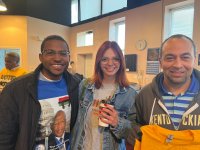
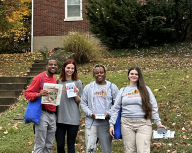
This weekend, KFTC members visited fatherhood programs at Douglas Park in Lexington and in the Boston community of Georgetown, registering voters and talking to people about our campaign to restore voting rights to former felons who have served their debt to society.
Many of our volunteers were former felons themselves. In addition to coming home with over 100 postcards to Senate President David Williams and Governor Steve Beshear, we had key conversations with former felons, folks at Alpha Kappa Alpha sorority (who have been actively working to support voting rights), first district Lexington councilman Chris Ford, and we even talked to a minister at a local Methodist church in Georgetown who pledged to talk to members of his congregation about this issue.
We also helped over a dozen people to start the process to request their voting rights back from the Governor individually and met three people who we intend to follow-up with to interview as part of our Former Felon Voices series on this blog.
June-16-2011
We're much stronger when we all stand up together
If you found yourself anywhere between Marmet and Blair, WV last week, you likely ran into a sea of red-bandana wearing rednecks marching along that 50-mile stretch. You would not have missed them, they were rolling at least 300 deep at all times highlighted in day-glow vests and shaded by large home made signs reading, “Appalachia Deserves a Clean, Local Economy”, “Appalachia Deserves Sustainable, Union Jobs”, and “Save Blair Mountain”, among others. As Appalachia Rising’s second mass mobilization, the march ended with rally of over a thousand people on historic Blair Mountain.
Among the brave souls marching and driving in for the culminating rally were over 50 KFTC members, and countless Kentuckians.
This March on Blair Mountain mimicked the march by over 10,000 miners for labor and union rights in 1921, the largest armed, working-class uprising in United States history, (not to mention the first time the U.S. government ever brought arms (and bombs) against citizens). However, this event was the first of its kind in many aspects. People from all over, community, environmental groups, and labor unions, including United Mine Workers of America local chapters, marched and rallied together in solidarity. They marched to preserve Blair Mountain, abolish mountaintop removal, strengthen labor rights, and for an investment in sustainable job creation for all Appalachian communities.
As you can imagine, hundreds of people walking on narrow, windy, mountain roads does not happen often, is not exceptionally safe, and involved inherent risk. East Kentucky members Russell Oliver of Perry County, Beverly May of Floyd County, and John Hennen of Rowan County participated in the full march and their words tell the story better than any bystander:
“Over half of local residents along the march route were very supportive of our march. On the first day of the march a local man who supported us sat on his four wheeler along the road, with flowers and a sign that read "THANK YOU", he felt that he could not stand up for this march because he might loose his jo
People from Canada, France, Australia, Japan, England, Israel and people from most of the United States were together. We marched and lived in SOLIDARITY.
The march was more successful than could have ever been imagined. Many local people in West Virginia supported us. It was a historical march that many felt could not be done, but over a 1,000 of us that were on the top of Blair Mountain on Saturday (the culminating rally) knew different.” –Russell, Hazard
“The thing that impressed me most about the whole week was the degree of commitment and sacrifice I saw from a generation of young people who are so often accused of being detached, shallow, and unconcerned with social justice. It was particularly inspiring to see the respectful interaction and genuine affection between the younger and older folks. Myles Horton often wrote and spoke about the years of organizational work that waits for the time a movement breaks out. We are in a movement phase now, and the organizational work continues.” – John, Morehead
“We're much stronger when we all stand up together for what is right!" - Bev, Maytown
Want to buy an ad to support KFTC?
As part of our 30th Anniversary celebrations this year, KFTC is creating a history booklet that will outline our work and our victories since our inception in 1981. To help pay for the booklet and other anniversary activities, we are looking for businesses, organizations and individuals who support our work to purchase ads to be placed in the booklet. Prices start at $20 for a sponsor listing and $40 for an ad. The deadline for purchasing an ad is July 15th.
For more information on sizes, pricing, example ads, and an order form click here. If you have any questions feel free to contact Erik.
June-14-2011
The Last Mountain
There's a powerful new video out about mountaintop removal mining called The Last Mountain that some of our members are considering showing in Lexington and Scott County. Here's a trailer:
Synopsis:
In the valleys of Appalachia, a battle is being fought over a mountain. It is a battle with severe consequences that affect every American, regardless of their social status, economic background or where they live. It is a battle that has taken many lives and continues to do so the longer it is waged. It is a battle over protecting our health and environment from the destructive power of Big Coal.
The mining and burning of coal is at the epicenter of America’s struggle to balance its energy needs with environmental concerns. Nowhere is that concern greater than in Coal River Valley, West Virginia, where a small but passionate group of ordinary citizens are trying to stop Big Coal corporations, like Massey Energy, from continuing the devastating practice of Mountain Top Removal.
June-13-2011
Former Felon Voices - Jason Smith, Hardin County
In an attempt to share more of the stories from former felons across the Commonwealth, we’re presenting a series of short interviews every few weeks on our blog.
A couple of weeks ago, Jason Smith, 32, from Elizabethtown succeeded in regaining the right to vote and plans on voting for the first time in the election this November.
But it wasn't an easy path getting there, he told us.
"My father was an alcoholic and I had a lot of problems at home growing up. I fled from that at a young age and managed to get my way through high school on my own, but I didn't always make the best decisions back then."
"When I was 18, I got caught with ½ ounce of Marijuana and an improperly stowed handgun in my car, and that was enough to put me in jail with a felony. I got put in with some pretty hardened criminals and gang members, which didn't exactly help me in turning my life around. To be honest, I looked to some of the older guys as mentors then and they weren't very good role models. I’m not blaming anybody for my own choices, but it was a bad path to get on."
"After I became a parent, though, I decided that I really need to turn my life around. It brought everything into focus for me. But my choices are really limited by my past."
"I went to college and did really well in school, though, learning to be a chemical dependency abuse counselor. I tell people that I got a PHD in the street and then sharpened that to a point with a college education. In all of that, I've learned a lot that I can use to really help people."
"After I realized I could apply to get my voting rights back through a partial pardon from the Governor, I knew I had to try. Because being silent in this Democracy and having my kids be silenced too by extension didn't seem right."
"I applied to get my rights back and then followed up by phone every couple of days, but never heard back."
"Finally, I visited the court in person and asked about my case. They claimed that I had a failure to appear to court offense on my record, but I knew that wasn't right. When I contested it, they told me that I'd probably have to get a lawyer."
Jason pushed back and stubbornly waited in the office until he could convince someone to take the time to look into it more deeply. Eventually, they found that the records of the Jason Smith they had on file belonged to a man with a different birthday, so Jason's application had stopped because of something another Jason Smith did.
"Admittedly, it's a pretty common name.," Jason says, laughing. Still, he notes that most people wouldn't have been persistent enough to push their way through a snag like that.
"I'm pretty bull-headed, really," Jason said. “I have a great education and I was willing to really follow-up on my application, but there’s people who don’t have my bullheadedness or luck and I'm afraid they’re not getting their rights back."
And indeed, over 120,000 Kentuckians haven't been able to navigate the process that Jason went through, but he's dedicated to helping them too.
"After I got my right to vote back, I posted the certificate on Facebook and a few other people approached me to see if I could help them get their rights back. I'm helping a few through the process right now."
He also spent some time looking for organizations that work on Voting Rights and discovered KFTC by finding a news story about our Voting Rights Rally in Frankfort earlier this year and managed to blow up one of the images big enough that he could make out the letters "KFTC."
“I have a loud enough voice on my own to get my rights back," said Jason. "A lot of people don’t, but KFTC helps other people to have a loud voice and I want to be a part of that. I've never done anything small im my life and I'm looking forward to doing something big with this."

Look here for news of mine safety issues.