Personal tools
You are here: Home KFTC Blog Archive 2009 October 15 Video and more updates from the Pikeville hearing
Subscribe to our blog!
RSS 2.0

Enter your email address to receive emails when this blog is updated:

Delivered by FeedBurner

Powered by Quills
Topics
Topics in Detail…
 
Archives
 
Find us on Facebook

Join KFTC!


Video and more updates from the Pikeville hearing

by Erik Hungerbuhler last modified October-15-2009 06:25 PM


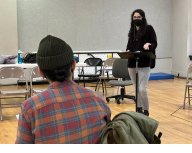
For those of you who were not able to attend Tuesday's hearing in Pikeville, we've pulled together a video of some footage from inside the expo center arena of members giving comments about the Nationwide Permit 21.  Some of the audio may be difficult to hear due to the acoustics of the arena and the noise from the crowd, but it ought to give you a pretty good sense of what it was like to be there.

And for those of you who were unable to attend, you can still submit comments electronically.  We are encouraging all of our members and allies to take a moment to submit comments in support of the Army Corps' proposed rule change on valley fill permitting.  We have an action page on this issue set up where you can learn more about the issue, read talking points and submit your comment.  You have until October 26th to submit your comments.

Additionally, we have created some pages with the text of some of our members' comments and other interesting quotes from the hearing.  Follow the links below to read them:

NW21

Posted by Leon Wood at October-15-2009 08:01 PM
NWP #21 and other nationwide permits are essential to the mining industry. The mining industry must comply with 23 different environmental laws and regulations. Permitting of new or expanded operations is taking years to obtain the necessary permits. With more than 250 coal permits backlogged at the COE, some for two years or longer, the Corp proposes to eliminate one regulatory tool explicitly designed to avoid regulatory duplication and unnecessary delays. The Corp has failed to provide a plan for how the agency will handle the increased regulatory burden. The COE is simply not prepared to handle the increased workload that will result should NWP #21 be abandoned. The COE has provided no scientific or environmental justification for eliminating the use of NWP #21. Further, the COE has provided no evidence of environmental damage or other public interest reason for eliminating the use of this permit, therefore, it appears the decision is driven by politics and not based on any concern with environmental protection. These type of decisions have an impact. The KY Coal industry employs over 17,000 miners and generates over 50,000 jobs in other areas of support. Ky exports 73% of its coal, bringing in over $3.5 Billion dollars into KY. Around 85 cents on each dollar stays here - wages, benefits, operating expenses, royalties, and taxes. The KY Coal Industry paid over $270.0 Million in severance taxes in 2008 in addition to the normal business taxes paid by all KY companies. The total revenue generated by the KY Coal Industry in 2007 was $4.9 Billion dollars. Almost 95 percent of the electric power in Kentucky is coal-fire generated. Kentucky’s electric power costs, in the industrial sector, ranked the lowest in the nation for the fourth consecutive year. Kentucky’s industrial power costs are over 15% lower than any other state east of the Mississippi River and over a third lower than the U.S. average. As a result of these low cost electric rates KY is the 4th largest automaker, 3rd largest Aluminum producer, and the 3rd largest Stainless Steel Producer in the US. Coal drives KY’s Economic Engine. The Obama Administration promised the American Public to make decisions based on Science. These type of decisions to consider elimination of NWP #21 are not science based they are decisions being made to change our energy policy and make us more dependent on Foreign Energy sources and their leaders. The decisions being made today cannot be made lightly these decisions will determine how and where our children and grandchildren live and what future battlefields they will fight and die on. Surface coal mining is our past, present and will continue to be our future.

Useful Information on Windmills

Posted by Todd at October-16-2009 10:10 AM
The comment section on the "Live Blogging" is getting to jumbled for me, so im going to start commenting under this blog entry.

Anyways, here is a link that somewhat explains the overall footprint of a windmill.
http://www.wind-watch.org/faq-size.php

Also, ive provided some photos that show what the footprint would look like in a Mountainous region as well.
http://www.wind-watch.org/pix/displayimage.php?album=1&pos=9

http://www.wind-watch.org/pix/displayimage.php?album=1&pos=10

http://www.wind-watch.org/pix/displayimage.php?album=1&pos=87

http://www.wind-watch.org/pix/displayimage.php?album=1&pos=88

As ive been researching through this information, Ive been wondering, what would Windmills do to property value? I havent found much information that talks about whether the property gains or loses value. Does anyone know?

Thanks,
Todd

Myths of the Wind Industry

Posted by Todd at October-16-2009 12:57 PM
http://www.stopillwind.org/lowerlevel.php?content=topten_intro

Interesting take on some of the questions Ive recently asked. Ive included the response to creating local jobs.

# 7. The wind industry will create many local jobs.

This is a cruel untruth, especially in economically depressed areas. Very few permanent jobs will likely be created—perhaps a couple of low wage maintenance employees. According to a report by the National Renewable Energy Lab on windplant jobs, the national average is one maintenance employee for every 12-15 turbines. A 20 turbine windplant in Meyersdale, Pennsylvania now employs only two maintenance employees. Forty miles south, the Mountaineer wind facility in West Virginia, with over 45 turbines, employs three to four workers. For two windplants proposed for Western Maryland (Clipper Windpower and Synergics Wind Energy, both LLCs), the developers have pledged to pay each of their maintenance employees little more than $18,000 annually, less than a living wage for a family of four in this country. The collective capital value of their facilities, however, is projected to be in the neighborhood of $140 million....

During windplant construction, a few security guards and some local earth moving crews will be hired for a few months, while the bulk of construction is typically completed by primarily foreign labor, since the turbines are often manufactured in Europe with warranties serviced by the manufacturer. A recent study by the Iowa Department of Natural Resources on the "Top of Iowa" windplant showed that, of the 200 total construction jobs, only 20 were local—and all disappeared within six months.

A Sustainable Economy and Renewable Energy CANNOT be Built on Coal

Posted by Cari L Moore at November-19-2009 04:39 AM
Hi Todd,

I hope that you will listen to the following with an open mind and perhaps, respond. I would like to address your point about wind farms. You say very few permanent jobs will "likely be created" by wind farms. Yet, MTR mining- and mining in general, won't always offer work to our citizens, like wind could, because coal is finite. At least wind jobs will last forever, even if they do employ fewer people. Coal will eventually employ 0 people, regardless of what anyone wants, because we'll run out of it. We have to find alternative jobs and alternative energy because coal is finite. If we do not, we will be left without jobs, anyway, after we've destroyed even more of our land and sacrificed some of our neighbors in the process. We'll be standing here asking, "Now what?," and our descendants will likely wish we had made better choices. MTR employees fewer people than underground mining would, anyway, and I would presume- since the process is faster- for a shorter amount of time.

Coal River Mountain, which is currently being blown up in West Virginia, would offer residents permanent jobs as a wind farm and would also bring in a LOT more in tax dollars than the coal severance will bring to the area. If I am not recalling incorrectly, I believe they estimated that the 200 jobs it would take to get the place up and running would last 2 years, unlike the 6 months you mentioned for the other area. They estimated it would create 40-50 permanent maintenance jobs afterwards. Also, it is estimated it will bring in more one year jobs within 27 years, than the coal mining of Coal River Mountain will in the entire time the mining will last there (about 14-17 yrs). So, overall, the wind farm will provide more one year jobs, and the only permanent jobs and sustainable energy that will come from either practice. Furthermore, it will bring in, as I said, much more revenue for the town in tax dollars than the coal severance will bring in. The wind farm is estimated to generate $1.74 million a year in taxes for that community, the coal severance is only $36,000 that I believe is to come in for 14-17 years. After that, there won't be any more money coming in from that coal.

If throwing that away isn't bad enough, the blasting threatens to damage a nearby coal sludge dam that could kill 900-1000 citizens if it fails. I hate- absolutely HATE- the word "casualty". It is offensive to me. So, while some people might consider such a loss of lives, simply an accident, an act of God, or a casualty, I call it the responsibility of the coal company who is endangering those citizens with their blasting, and I call it willful disregard for human safety. I would also call it a tragedy. Things such as that are the true cost of coal. Surely, we should all care about the lives of the people in our state and the rest of Appalachia. How can these people even move out of harm's way? How many people will pay them for their home beneath a container of toxic waste, knowing that if it's released due to dam failure, it will kill the inhabitants? How many people would pay for such housing if they know that blasting is taking place nearby and threatens to damage the dam? In a poor region such as that, those people prob. can't afford to move without selling their homes. What are they to do, but wait and pray that dam doesn't fail? I know it is easy for folks that don't live beneath such dams to say these things happen, but ask yourself honestly, what if those people were your family, your friends- or even you?

In 1972 such a break in West Virginia killed 125 people, injured over 1,000, and left over 4,000 homeless. This is the true face of coal. A few years ago, a 3 year old boy in Virginia was crushed by a boulder dislodged on a strip job on Black Mountain. That is the true cost of coal. There are no casualties. Only the unacceptable, avoidable loss of innocent life.

I realize people want jobs, and I can respect people trying to take care of their kids (as many folks do not and should), but I do not respect this way of obtaining money. I do not respect that it endangers the health and futures of other kids (and adults) and has indeed, killed people both in an outside of the industry. I do not respect that it is destroying our land and our culture. I do not respect the act of living in an area one claims to love, while simultaneously destroying it, instead of seeking a job elsewhere. I am not trying to act holier than thou- I am referring to the practice not the people. The law doesn't protect many other ways of making money that cause harm to innocent people, and this should not be an exception.

Let me offer you this for thought- I have some relatives who worked underground 60-70 years ago. I know they would have preferred to work somewhere besides the coal mines, since it was hard, dirty, dangerous work with a poor salary and they had no union to protect them. During that time, there was a big strike and some of the miners stood on the picket lines with guns threatening to shoot whoever tried to work, until they got better treatment. During the history of the coal companies, some miners lived on coal camps the company owned, were paid money only good at the company store, etc. Who would WANT that life? I know some of my relatives would have preferred other work, but they took the jobs, since they had little options. My grandpa only retired, to my knowledge, because he got black lung. Now, 60-70 years after some of those relatives were working, and over 100 years after the coal camps were here (they didn't disappear until more recently, though), we still have so few options. Actually, the first commercial mine that opened in KY from what I've read, was in 1820. That was almost 190 years ago. We are told that coal is running out now, and will not last much longer- and common sense will tell you its going to run out because it is a finite resource- yet the people in power are not scurrying to try to find new jobs for the region, nor sustainable energy. Instead, they fight against new jobs and destroy opportunities (with MTR) that could give us a sustainable, diversified economy, more jobs, and lasting energy. We need to be asking ourselves, WHY after ALL this time, and our long standing knowledge that we are going to eventually run out of this resource, do we still not have any more options here? We better be getting them soon, or else we're going to be stuck here without jobs or energy when it's all gone. Your kids- or I'd venture to say, your grandkids if not your kids- are going to be without coal jobs, most likely, at the rate the coal is being mined and used, anyway. Shouldn't we leave them with something? In the meantime, we have to ask ourselves, "How much are we willing to sacrifice?" I say, "We've sacrificed too much already!"

Another Windmill Link

Posted by Todd at October-16-2009 02:11 PM
Last link of the day...

http://www.keepersoftheblueridge.com/faqs.html