I Love Mountains Day 2009
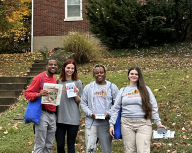
It was a great event! I Love Mountains Day 2009 saw another strong turnout in Frankfort as hundreds marched and rallied in support of clean water and protections for Kentucky's mountains and coalfield communities. The march was energetic, the speeches were phenomenal and the determination to retake state government from special monied interests was undeniable.
"I'm glad to be here today with people who are not afraid. We can take back our democracy. We're doing it, we're doing it today," said KFTC Chairperson K.A. Owens.
Watch a short video of the event by David Stephenson, photojournalist with the Lexington Herald-Leader, or another video by Mike Wynn of the Winchester Sun.
| View this photo album by Ann Olson |
More than 700 people started the rally in downtown Frankfort at the Kentucky River, whose headwaters are severely damaged by coal company pollution. This included a group of people who had marched from Lexington to Frankfort to draw attention the issue.
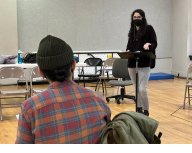
The crowd marched — including 96-year-old Marie Cassidy from Louisville — about a half mile to join a another crowd waiting for them on the front steps of the state capitol, greeted by music from Ben Sollee and David Martin Moore. Speeches by Sen. Kathy Stein, Rep. John Yarmuth, K.A. Owens, Randy Wilson, Silas House, Ashley Judd, Lyle Snider, Willa Hood, Emily Gillespie and Teri Blanton, as well as music by Public Outcry and the Reel World String Band followed.
Willa Johnson talked about growing up in McRoberts in Letcher County where abuse by coal companies is a daily occurrence.
"I am 23 now, and still live in the mountains I love, and my family still struggles to hold on to what is theirs. My grandfather, a retired coal miner, at the age of 84 fights daily for his land. His home is falling apart from the blasts, boulders litter the family cemetery behind his home and the MTR company behind his home trespasses to clean up their dirty mess from time to time thinking that he doesn't realize what is really going on. What that company doesn't know is that age doesn't matter, strength and determination is what counts, and at 84 years old he's going to keep fighting for what he loves."
Featured speaker Ashley Judd was equally strong in her condemnation of the coal industry's disregard of people and planet.
Let me be clear.
Mountaintop removal coal mining is a tragedy.
Mountaintop removal coal mining is a scourge on our people and on our land.
Mountaintop removal coal mining is devouring vast acreages of irreplaceable hardwood forests, filling our sacred hollows, burying precious headwater streams, and eliminating wildlife habitat. And, with its monstrous equipment and mechanization, it is also eliminating coal miner’s jobs.
But the emphasis was largely on water, protecting Kentucky's rivers and
stream from the coal industry's practice of dumping its toxic mining
wastes into the headwater streams of the Kentucky, Big Sandy,
Cumberland and Licking rivers in eastern Kentucky. "Not One More Mile" was the chant for the day as the defenders of Kentucky's precious people and places said that 1,400 miles of streams buried or severely damaged by this practice is already way too many.
Speakers emphasized that by being so bound to coal and protecting the industry that Kentucky is losing out on opportunities to transition with the rest of the nation to a green energy economy. Some of the loudest cheers came when speakers talked about bring these jobs to the coalfields.
|
|
||
Media coverage:
- Ronnie Ellis with CNHI News Service
- Charlie Pearl in the Frankfort State Journal
- Tom Eblen in the Lexington Herald Leader
- David Stephenson's video in the Herald-Leader
- Mike Wynn in the Winchester Sun
- James Bruggers in The Courier-Journal
- Kristin Espeland on WFPL-FM
- Silas House blog
- Mark Grayson at thelevisalazer.com
I Love Mountains Day building New Power
We know at this point that we are talking to the people. But we the people must be a part of the New Power.
Its time to return government to the hands of the people. Government is supposed to help people not oppress them. We have lost sight of this some where along the way. Its time to return to the roots of our Democracy. Grassroots that is.
I Love Mountains Day - But what about Concrete Jungles?
Thanks.
concrete jungles
you asked a queston that I among many other have asked on here and havnt got a answer yet.IMO the concrete jungles has nothing to do with the mountains,coal and other stuff.Eastern Ky has been picked on,discrimated against,made fun of just to name a few of the stuff.i agree the coal industry needs to be cleaned up but so much other stuff does also like gas well sites and logging but i dont see this crowd doing anything about them and they hurt just of much if not more.they have no silt control.logging dont plant trees back just to name aa few of the stuff they do. i had rather look at grass growing or deer,elk turkey and other wildlife than a tall building anyday.some have said on here strip mines dont support wildlife but they havnt acccepted a challange from me to go and see some ponds where can catch fish,see elk,deer turkey and other wildlife.they have tunnel vision when it comes to coal.KFTC does a lot of good in some things but trying to end MTR is not a good thing.it will hurt the local area,the nations ecconomy plus put a lot of people out of work.
Urban & Rural issues
But to keep things in perspective. Last week the Kentucky Environmental Quality Commission had a meeting and one report from a UK research was about the change in the vegetative ground cover for the state. 2% of the change statewide was due to housing/commercial development, 65% was due to lost of forested land due to logging and mining.
Keep asking questions Todd!
Water Issues
No doubt, mining and logging are leading the way in regards to a decrease in vegetative ground cover. When you think about it, you may have a 20 acre subdivision in which you may lose 35% to 45% of the original ground cover and in mining operations you are talking about 100s of acres of trees and vegetation being destroyed. Its easy to see that industrial would be the largest contributor to this loss.
My question is this, what is the difference in stream functions, versus Lexington and Eastern Kentucky? We know that Valley Fills are dumped into headwater streams, which pollute and disrupt the natural routine of a stream. Any function the stream was providing before hand has been severely altered, because you take away what mother nature has already perfected. What about in Urban areas? Ive heard the argument that they are not "filling" over these streams, they are rerouting them through concrete channels, culverts or a rock ripped channel. These changes also have serious repercussion to the function of that stream. The habitat is destroyed and the stream is straightened which will usually cause erosion or flooding when it finally reenters the stream bed.
Im no expert on the above situations, I read and try to think in a logical manner about these issues. So if im way off base, please correct me. Im very interested in continuing this discussion!
Todd
vegetative ground cover
Urban & Rural continued
Good discussion. Urban first. Typical development, especially replacing vegetation with hard surfaces drastically changes the the natural/existing water systems. This often turns what was a natural periodic water channel into nothing more than a storm water channel. This is why there has been such a dramatic increase in urban flooding. This is compounded by the old practice of dumping storm water into the sanitary sewers and why the EPA has sued the city of Lexington. Development practices have gotten better with silt fences during construction and new regulations requiring more vegitative surfaces and porous paving. Still, there is lots of room for improvement.
Noe rural and especially the mountain areas. During logging and surface mining, regulations are minimum and difficult to enforce in controlling silt release - logging especially. Though surface mining does do "reclamation" (I won't debate the quality of that here) with vegetation, it has completely destroyed the subsurface hydrological structure. The once was a natural way for surface water to be purified is gone. Coal in its natural state acts as purifier, like the the charcoal filters people put on their faucets. When disturbed, coal releases all of the contaminates it was holding.
My last point, it still is a matter of scale 2% vs. 65%.
Email me personally if you want but I think that others are looking at our discussion with interest. martin@kftc.org
logging and such
More Questions
I thought the rock overlaying the coal is what contributed to the contaminates in a stream? From my experience, when you place shot rock, such as sandstone in a stream and rainwater runs through it, that's when the contaminates begin to enter the stream. Im not sure exactly what happens but I do know that the conductivity of stream will skyrocket after this happens. Anytime you have a major increase in conductivity it simultaneously disrupts the stream habitat.
Do you know of any independent studies on the Ecological Integrity of streams after mining has been completed? Not immediately after, im talking 15 to 20 years? I ask this because, I wonder what happens after this amount of time. Ive visited several sites that are 15 to 20 years old and when you conduct bug counts, habitat scores and collect water samples, they are significantly lower than immediately after mining. Of course, ive also visited just as many sites that remain completely out of whack. So what is the difference? What would cause this?
Thanks for the conversation its extremely interesting.
Todd
More Questions
Mining Impacts
Ive also seen similar situations where Black sided dace have strived, although ive never seen a cold water trout stream with mining in behind it. Thats why I believe certain layers of rock contain the contaminants that pollute most streams. This also would explain why some previously mined areas are starting to revive its habitat.
Mining Impacts
More Questions
I think that we can agree that the natural world is fascinatingly complex. Often, despite our best intentions and research, our actions prove that we have made a mistake. I think that the last forty years of experience and science has shown us that surface mining creates more problems than benefits. The history also shows that we do not need to destroy such enormous amounts of land just to extract coal and that there are better ways to create energy and jobs.
I think F would say that logging is just as destructive and he is right. Trees are a renewable resource and experience and science have shown that it is possible to harvest trees without destroying the soil that enables them to be replaced.
I think that we need to admit that there is some coal that just should not be mine and there are some forests that should remained untouched - the short-term benefits are not worth what we may lose permanently.
Thanks for the discussion and welcome Leon.
Martin
More Questions
The other point I want to respond to is "we need to admit that there is some coal that just should not be mine". How do you decide this and who makes this decision? As a property owner, if I choose to have this property mined should someone else be able to tell me that I cant? Has KFTC ever entertained the idea of purchasing the property?
What is the KFTC stance on Stream Mitigation and Restoration? Not only in Eastern Kentucky but the entire state. Alot of money has been paid into the Fish & Wildlife fund and I cant find any evidence as to where the money has went. In my opinion, stream mitigation is something that could be a positive impact for the state of Kentucky. The program could grow to include acquiring entire watersheds to prevent any type of mining or industrial activities.
I love the the discussion, its been very civil and full of information. Thanks to everyone thats participating.
Todd

Click here for news about recent mine disasters.
I Love Mtns Day makes PerezHilton.com
This may seem trivial but this years event, and Ashley Judd, made Perez Hitlons blog: http://perezhilton.com/2009-02-17-angelina-jolie-ashley-judd-is-getting-all-activist-again
He gets upwards of 2.8 million visitors per month (not individual hits but individual viewers, many visitors will visit his site everyday - Wow!) so its great exposure to an unusual audience!
Well done, everyone! Keep up the great work!